The dishwasher line failed after dinner, you mopped the puddle, and the luxury vinyl still looks new. That is the usual first hour of vinyl plank water damage in a San Diego County kitchen. The plank can stay glossy while water sits in the pad, the core, or the subfloor under it.
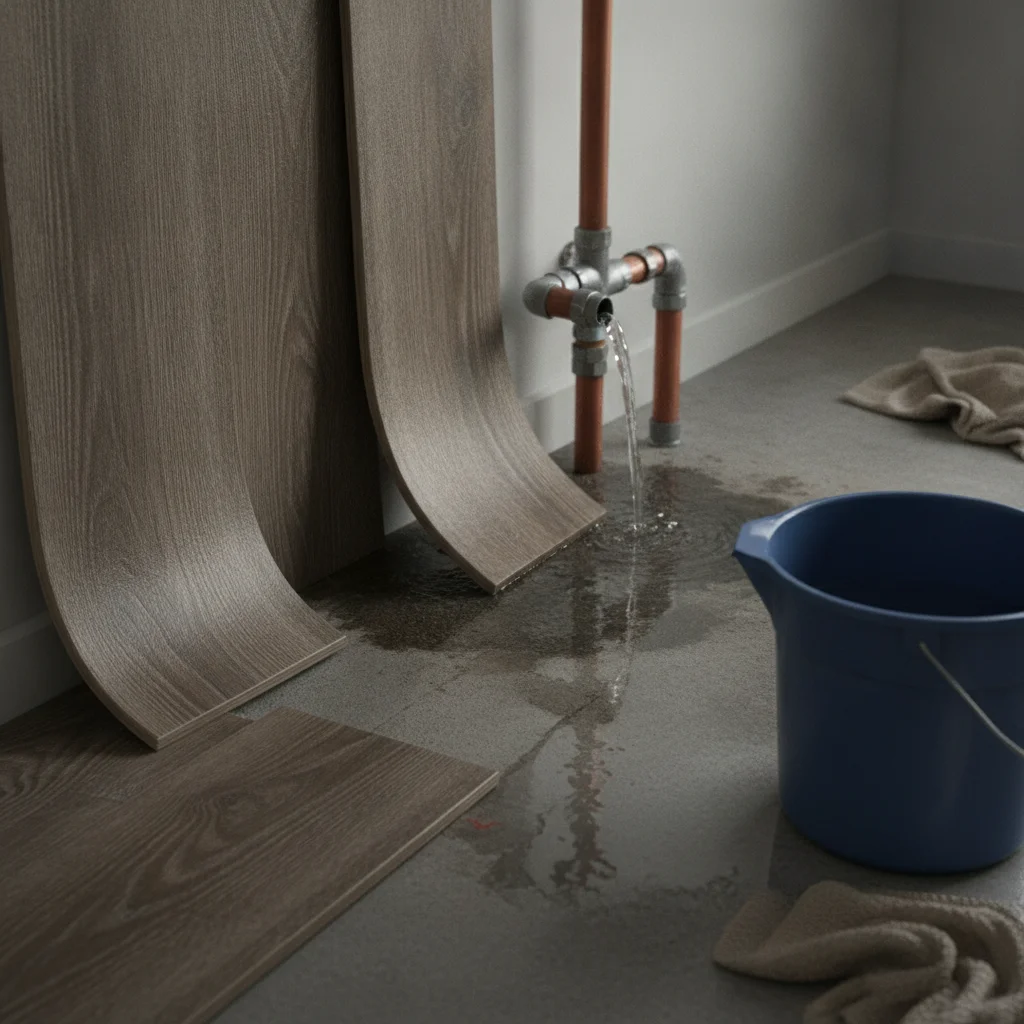
How a leak reaches the plank and what’s below it
Luxury vinyl plank, often sold as LVP, shows up in a lot of San Diego County remodels. Kitchens in Chula Vista tract homes, laundry rooms in Mira Mesa condos, and baths in Encinitas bungalows get it for the same reason. The plank shrugs off a spilled glass.
A leak is a different event. Water from a dishwasher line, a fridge supply, a toilet flange, or a washing machine does not stay in a tidy puddle. It runs to the lowest point. It finds the joints between planks. It slides into the expansion gap hidden behind the baseboard. It follows the kick of a cabinet and disappears.
A finished vinyl floor is a stack. On top sits the wear layer and the vinyl core. Under that you may have a thin foam pad, a separate underlayment, then the subfloor. In much of East County, the South Bay, and newer inland tracts, that subfloor is a concrete slab. In older coastal neighborhoods and some North County raised homes, it is plywood or OSB over joists.
Joints between planks resist a splash. They do not make a sealed tank. Standing water, or a slow seep along a wall, moves sideways under a floating floor. Glue-down vinyl has fewer voids. Water still finds cut edges, transitions, and the gap at the tub.
Once water is under the plank, that closed surface holds the moisture in. Air cannot reach it. The pad soaks. Wood subfloors swell at the edges. A slab holds a film that keeps the room feeling damp. That is how water gets under vinyl plank flooring in a room that still looks fine.
Why a dry surface can hide a wet core or underlayment
You wipe the wear layer. It looks dry in an hour. That only tells you about the skin of the plank.
Water under LVP has nowhere to go. The planks act like a lid. Underlayment stays wet. A WPC core (wood-plastic composite) can take water in at a damaged lock or a cut end. An SPC core (stone-plastic) is denser, and water still sits on everything below it. Specific manufacturer salvage rules for those cores could not be confirmed here. Treat a waterproof label as a surface claim. It is not a promise that the floor assembly stayed dry.
What you may notice later is quieter than buckling hardwood. A sour or musty smell near the toe-kick. A gray shadow under a plank by the island. An edge that catches a sock. A spot that gives when you step. Peaking at a seam. Baseboard that feels cool or dark at the bottom.
The EPA says to fix plumbing leaks and other water problems as soon as possible and dry items completely. If the water was sewage or another contaminated source, the EPA says to call a professional experienced with contaminated-water damage. That is sewage cleanup work.
Mold is a separate problem from the pretty plank. Allergic reactions to mold are common and can be immediate or delayed. Mold can also trigger asthma attacks in people with asthma who are allergic to it. It can irritate eyes, skin, nose, throat, and lungs in people who are allergic and people who are not. The EPA’s homeowner cleanup tips apply when the moldy area is less than about 10 square feet, roughly a 3 ft by 3 ft patch. If there has been a lot of water damage, or growth covers more than 10 square feet, consult EPA mold remediation guidance. Do not paint or caulk moldy surfaces. Clean and dry first. Paint over mold is likely to peel.
If you suspect the HVAC is contaminated with mold, do not run it. It can spread spores through the house. Confirm the cleanup steps on the EPA mold pages. For the wider moisture path in this county, see will water damage grow mold.
What the independent pro checks before a save-or-replace call
Restore Pro SD matches you with a licensed independent restoration pro. The brand does not lift floors, take moisture readings, or decide salvage. The pro you are connected with does that work.
If electrical circuits or equipment are wet or near water, power comes off at the main breaker only when that panel can be reached without walking through standing water. Never switch power on or off while standing in water. If you cannot reach the panel dry, call an electrician.
The matched pro then maps the stack, not just the shine on top. They stop the source if it is still running. They sort clean supply water from contaminated water. They check how far moisture traveled under a floating field, which often moves well past the original puddle. They take meter readings on the plank face, the pad, and the subfloor. They may unclick a plank to see the lock, the underlayment, and the wood or slab underneath. Soft OSB, swollen plywood edges, or a wet slab change the call.
LVP water damage save or replace is a call about the whole assembly. Planks that still lock, with a pad that can come out and a sound subfloor, may go back down after the structure is dry. A wet foam pad usually comes out. Swollen wood, contamination in the pad, or a lock that crushed when it swelled, points to replacement of that section. A floating floor shares one connected field, so the wet area can be larger than the stained corner you can see.
Ask the pro to show you the meter and the lifted corner. A guess from the doorway is not an inspection.
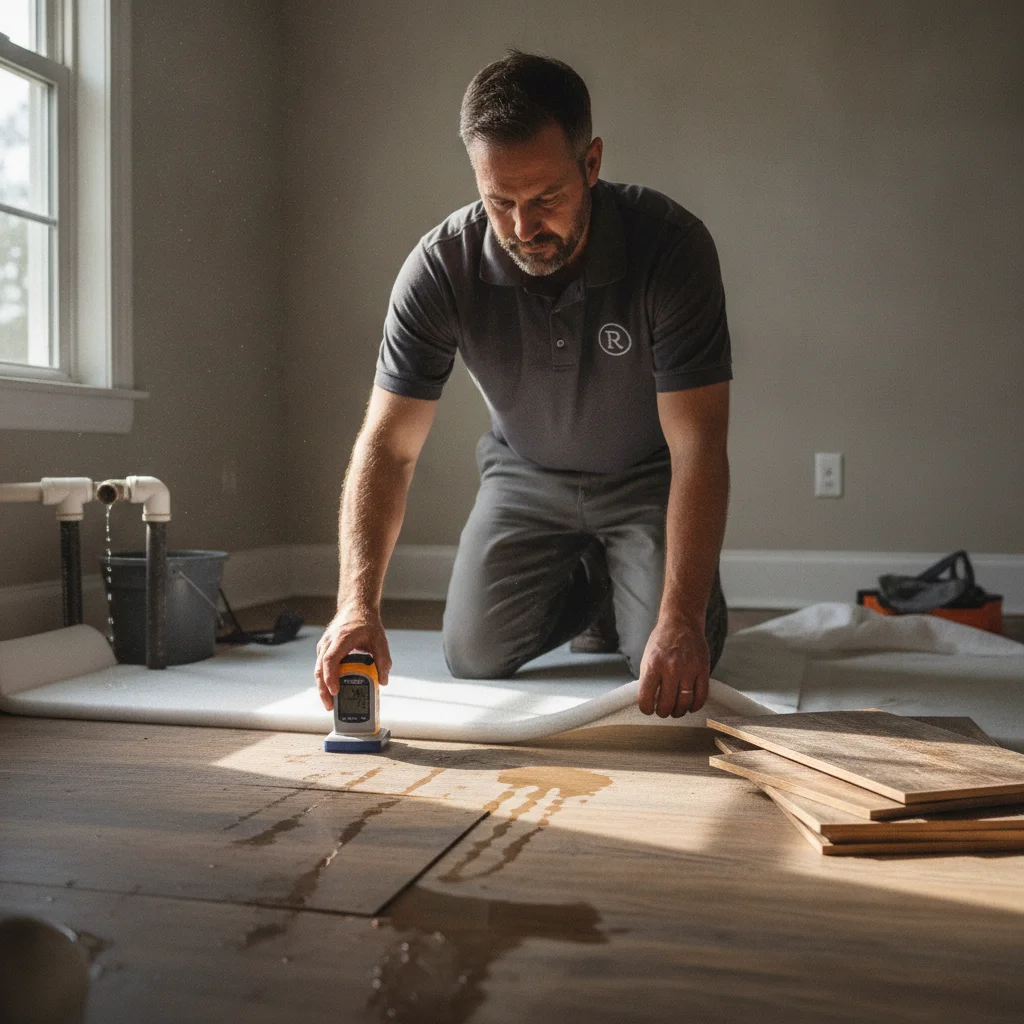
Separate flooring decisions from structural drying
New vinyl over a wet slab is how the smell comes back in July. Structural drying is the work of pulling moisture out of the building materials: the subfloor, the bottom plate, the drywall at the toe-kick, the insulation behind the dishwasher.
Vinyl plank flooring after a leak is a different problem from laminate or hardwood. Laminate has a fiberboard core that swells once it takes water. Hardwood cups and crowns on the face. Those paths are covered in laminate floor water damage, save or replace and water-damaged hardwood, save or replace. LVP often looks unchanged while the pad or the wood below it is the failure. That is why a dry-looking floor can still need the same wet-subfloor work as a room that already buckled.
Coastal North County rooms sit in marine-layer humidity. Inland East County rooms heat up and drive moisture deeper into a slab. The matched pro documents moisture in those materials until they are dry. There is no single published hour count that fits every San Diego house, every core type, and every leak. New flooring waits on that documented dry state, and on how the room feels to your hand.
Keep the flooring bid and the drying scope as two conversations. One person may do both. The sequence still matters. Dry the structure. Then talk about which planks return and which go to the dump.
What to review before new flooring is installed
Confirm the leak is actually dead. Slab leaks under older San Diego slab homes are a common repeat. So are pinched fridge lines and slow flanges behind a toilet. If the source is still wet, the next floor fails the same way.
The subfloor should be dry and sound before anyone clicks new LVP. Wet pad is trash. Do not install over mold, and do not paint or caulk a moldy surface to hide it. If there has been a lot of water damage, or visible growth covers more than about 10 square feet, the EPA says to consult professional mold remediation guidance. If you know or suspect the HVAC is contaminated with mold, leave it off until that is handled.
Check licenses before anyone cuts a floor or opens a wall. Water damage restoration repair work in California is licensed by the Contractors State License Board. Restore Pro SD is a referral service. It holds no contractor license. The independent pros in the network do. You can confirm a contractor on the CSLB license check.
If you rent, California Civil Code 1941 requires the landlord, absent an agreement to the contrary, to put the place into a condition fit for occupation and to repair later dilapidations that make it untenantable. Civil Code 1941.1 treats a dwelling as untenantable when it substantially lacks listed characteristics, including effective waterproofing and weather protection of roof and exterior walls, plumbing maintained in good working order, and floors maintained in good repair. Civil Code 1942 is the repair-and-deduct path after notice, with limits: the cost may not be more than one month’s rent, and the remedy is not available more than twice in any 12-month period. Details for tenants sit in rental water damage, tenant and landlord.
Leave expansion gaps, transitions, and the toilet wax for the flooring installer after the structure is dry. Heavy appliances on a soft spot will telegraph a wet subfloor. Move them only if you can do it without standing in water.
When to call us
Call when water has run under vinyl plank, when the room smells musty after a “dry” mop, or when a soft spot shows up by a cabinet, toilet, or appliance. A licensed restoration pro in our network can open the stack, dry the structure, and separate save from replace. Call us at (858) 400-4586 and we’ll connect you with a licensed local restoration pro.