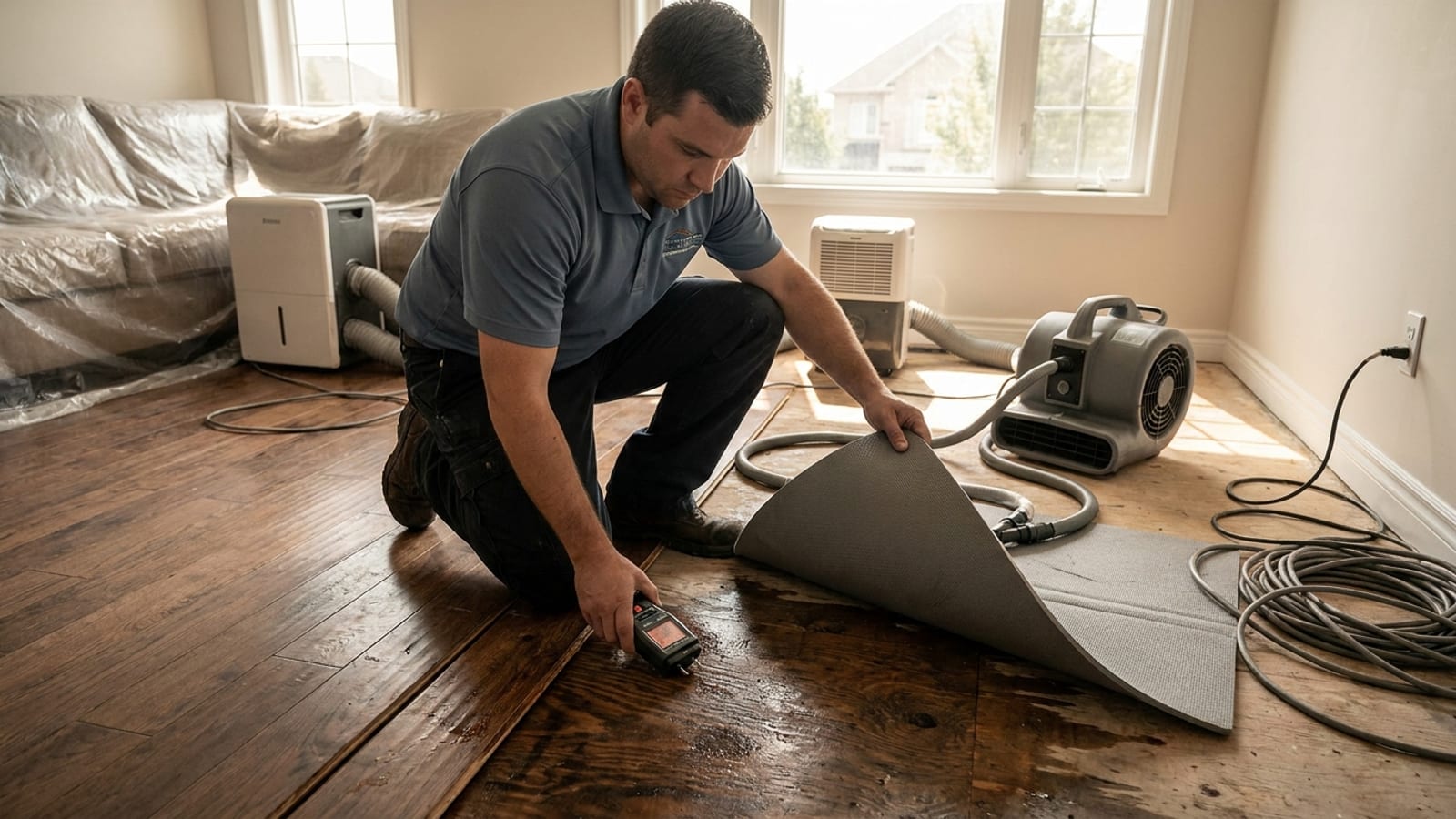
The surface dried two days ago. The carpet feels almost normal. Then you find a soft spot by the fridge, a new squeak at the bathroom door, and a smell you cannot place.
That is often the subfloor. Restore Pro SD matches you with a licensed independent restoration professional. We do not send a brand crew. The customer contracts with that professional.
Direct answers
What is the subfloor? The wood layer under finish flooring, usually plywood or OSB on joists. Water gets there through seams, around appliances, from a slab leak, or from a wet crawlspace.
How do you know it is wet? Soft spots, new squeaks after a leak, cupped hardwood, or a musty smell with no visible puddle. Tile and vinyl can hide water underneath.
What not to do? Do not assume fans on top of tile or vinyl dried the wood below. Finish floors can trap moisture. EPA guidance is to fix plumbing leaks as soon as possible and dry items completely.
Who checks it? An independent professional with a moisture meter. Ask them to compare wet spots with a dry room of the same materials.
How water gets there
Overflows find the seams in vinyl plank and tile and sit against the wood. Appliance leaks (ice-maker line, dishwasher hose, washer drain) can drip for weeks before the floor feels wrong. Slab leaks in older slab-on-grade neighborhoods can wet the assembly from below with no puddle. Coastal crawlspaces with a weak vapor barrier can add humidity from underneath.
What it feels like
A healthy subfloor is solid. A wet one gives near edges or between joists. Squeaks after a water event are often swollen wood against fasteners, not settling. Hardwood cupping (edges higher than the center) usually means moisture below. See save or replace hardwood.
A musty smell is a reason to stop the leak and get readings. It is not a lab report. EPA still says dry completely. Sewage or other contaminated water is a different job.
Why the surface can lie
Tile, vinyl plank, and laminate can act like a lid. Air movers on top move room air. They do not always move air through the wood. OSB swells and may not return to flat. Plywood holds up better and can still warp at the edges.
What to ask the independent professional
- How they will map moisture through the finish, not just by touch.
- Whether the finish has to come up, or whether they can dry the assembly another way.
- How they will dry joist bays if those are wet. That is structural drying.
- What reading they will use as done, compared with a dry room.
- Whether replacement of a panel is safer than drying swollen OSB.
Water damage restoration is that sequence: stop the source, remove free water, dry the structure, then repairs.
When replacement is the conversation
Ask them to show you buckling, spongy spans, or visible growth on the wood. Those are reasons they may recommend cutting a section rather than drying in place. Restore Pro SD does not quote that work or pick the carpenter.
When to call
If the floor is soft, newly squeaky, cupped, or smells wrong after a leak, get a moisture assessment before you lay new finish over it.
Call Restore Pro SD at (858) 400-4586. The line takes a recorded message. We match you with a local licensed restoration professional. They contract with you directly.