Standing water on a Del Mar floor is the start of cleanup, not the whole job. A beach-level living room, a village condo off Camino Del Mar, and a Heights house above I-5 can all take on water, and each house holds that moisture in a different way. Get the source straight, record every wet room, then let a licensed independent restoration pro handle the indoor work.
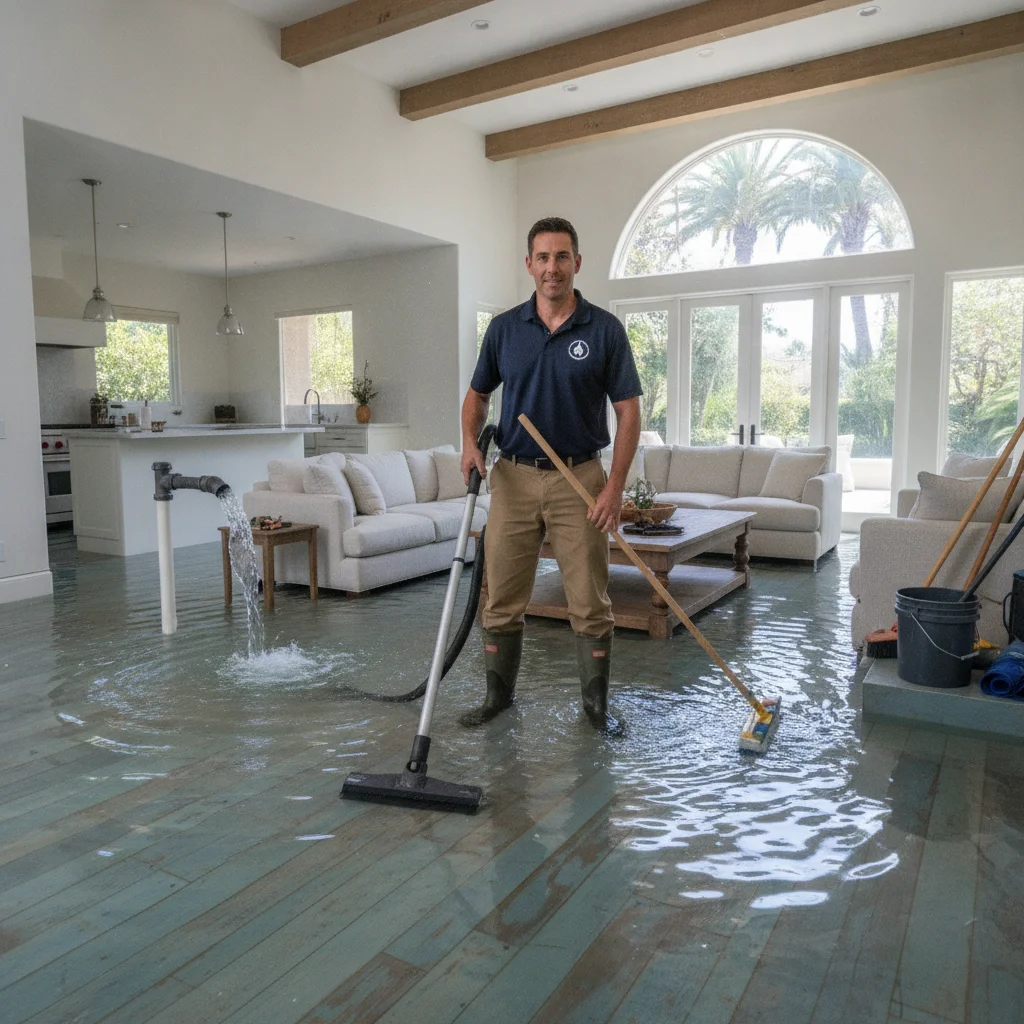
Identify how water entered the home
Water in a Del Mar house follows a path. Cleanup that skips that path leaves wet material in place and can spread contamination into rooms that still look fine.
Start at the lowest wet point and work backward. A supply line under a kitchen sink, a failed water heater in a garage, a tub that ran over, and stormwater at a low door are four different jobs. The EPA says to fix plumbing leaks and other water problems as soon as you can, then dry items completely. If the water came from sewage or another contaminated source, that same EPA guidance says to call a professional experienced with contaminated-water damage. Treat that water as a health problem from the first look.
Stay out of the wet if power is in play. The CDC says to turn off power at the main breaker only when you can reach it without walking through standing water. If you cannot reach it that way, call an electrician. Never switch power on or off while you are standing in water.
Coastal North County adds its own mix. Homes near the San Dieguito River and the Del Mar Fairgrounds sit on lower ground than houses up in Del Mar Heights. That fact does not place every north-end parcel in a flood zone. It does mean river water, lagoon water, and storm runoff share a corridor you should check on current maps. Along the village and Beach Colony streets, wind-driven rain and door thresholds at street grade show up often. Many Del Mar houses sit on a slab or a crawl space. A wet garage or a downhill lower level is the closer analog here than a deep East County basement.
Roof leaks and stucco seepage during a Pacific storm are building problems. Stop the indoor spread only if you can do it without entering standing water. Leave the roof, the private drain line, and the street inlet to the trade or the city desk that owns them.
If water is still pooled in the room, water extraction in Del Mar is the step that lifts it. Flood cleanup is what follows: soiled contents, wet finishes, and the hidden paths into walls and floors.
Document affected rooms before cleanup starts
Photograph before anyone pulls carpet or cuts drywall. The record is part of the cleanup, and it is the part you can do while you wait for a licensed pro.
Walk each affected room with your phone. Shoot the whole room, then the baseboards, then the underside of furniture you can move from dry ground. Open cabinets only if the floor is safe to stand on. Note the time. Note which rooms were still dry. Insurance files and the restoration pro both work from that set. Coverage still depends on your policy and on how the water entered. That is a separate question from cleanup. You can read how homeowners insurance treats water damage before you assume a check is coming.
Write down what you can smell and see. Musty air, dark edges on drywall, and swollen particle board all belong in the notes. Do not paint or caulk over those marks. The EPA says not to paint or caulk moldy surfaces. Clean and dry first. Paint over mold is likely to peel.
Contents need a simple sort. Hard, cleanable items can wait in a dry room. Porous things that sat in contaminated water are a poor DIY wash. If sewage or outdoor floodwater reached them, leave that call to the restoration pro. Throwing everything out in a panic makes the claim harder and leaves the structure wet.
If you rent, California Civil Code 1941 requires a landlord, unless you agreed otherwise, to keep a dwelling fit to occupy and to repair later dilapidations that make it untenantable. Civil Code 1941.1 treats a dwelling as untenantable if it substantially lacks effective waterproofing and weather protection of the roof and exterior walls, plumbing in good working order, or floors in good repair. Civil Code 1942 is the repair-and-deduct path after notice, with limits: the cost may not exceed one month’s rent, the remedy is unavailable more than twice in any 12-month period, and it does not apply if you caused the condition through lack of ordinary care under Civil Code 1929. Give notice in writing when you can. Cleanup of the wet rooms is still restoration work. It does not replace that notice.
Check walls, flooring, and adjoining spaces
Water on a Del Mar floor rarely stays in one rectangle. It follows the slope of the slab, the cavity in a shared village wall, and the gap under a vinyl plank.
Press along baseboards. Soft drywall, dark seams, and bubbling paint are clues. Check the room on the other side of the wet wall, the closet, and the hallway. In stacked condos along Camino Del Mar, look at the unit below if you are upstairs, and the ceiling if you are downstairs. Ask the association before anyone opens a common wall.
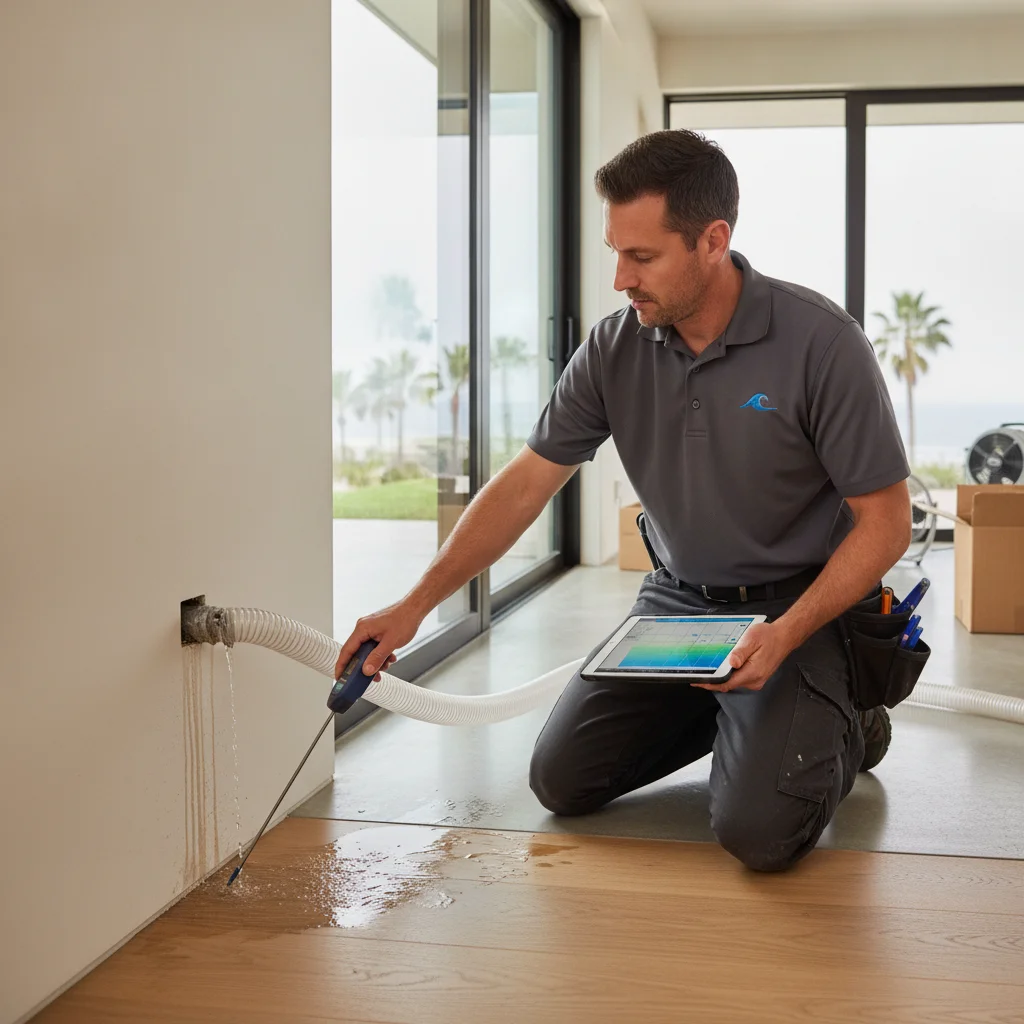
Flooring hides the slow part of a flood. Carpet padding stays wet after the surface feels dry. Laminate and vinyl can trap water at the edges. Tile can look fine while the setting bed is still wet. A licensed restoration pro maps that with meters. Your job is to find the rooms that need that map.
Pull back from the HVAC system. If you suspect the system picked up mold, the EPA says to consult its duct-cleaning guidance before you do more, and not to run the HVAC if you know or suspect it is contaminated. Marine-layer air along this shoreline already holds moisture. Pushing that air through a dirty system spreads spores through the house.
Adjoining spaces include the garage, a downhill laundry, and a crawl opening if the house has one. Olde Del Mar cottages, bluff houses, and Heights lots do not share one floor plan. Check what this address actually has.
If mold is present, size it. The EPA says that if the moldy area is less than about 10 square feet, roughly a 3 ft by 3 ft patch, a homeowner can handle cleanup in most cases using EPA tips. If there has been a lot of water damage, or mold growth covers more than 10 square feet, consult EPA mold remediation guidance. Allergic reactions to mold are common and can be immediate or delayed. Molds can cause asthma attacks in people with asthma who are allergic to mold. Mold can irritate the eyes, skin, nose, throat, and lungs of both allergic and non-allergic people. That is EPA language, not a diagnosis. Talk to a health professional if someone in the house is reacting.
Separate cleanup from drainage and repairs
Indoor flood damage cleanup is a defined scope. It is the wet interior. It is not a new roof, a new sewer lateral, or the City of Del Mar clearing a street inlet.
The independent restoration pro you hire handles remaining water, soiled materials that cannot be saved, surface cleaning, and structural drying of what can be kept. Drainage is site work and public infrastructure. Gutters, area drains, and the municipal storm system sit outside that interior scope. If water came in from a yard drain or a street, say so in your notes. Then call the trade or the city desk that owns that pipe.
Plumbing and roofing repairs are the same split. A plumber stops a supply line. A roofer stops a wet ceiling from refilling. The restoration pro does not replace those licenses. Water damage restoration repair work in California is licensed by the Contractors State License Board. Restore Pro SD is a referral service. We match homeowners with licensed, independent local water damage professionals. We hold no contractor license, own no trucks, and give no warranty. The customer contracts and pays the professional directly.
Keep those invoices separate. Mixed scopes hide what was cleanup and what was a remodel. If you are comparing companies, compare the indoor cleanup line. Our guide to flood cleanup scopes walks through that split.
Skip ozone machines sold as air cleaners. The EPA reports that at concentrations that do not exceed public health standards, ozone has little potential to remove indoor air contaminants. Ozone can be harmful. For chemicals it does react with, the reaction can form irritating by-products.
There is no verified Del Mar flood-cleanup price in our claims ledger, and this page will not invent one. Basement-flood price lists you see online often describe a different housing type than a slab cottage west of I-5. The independent pro prices the job from the rooms they measure. Ask for that scope in writing.
Verify Del Mar details through current official sources
No article can tell you that your Del Mar parcel sits in a flood zone. That is an address-level reading on a current map.
Start with FEMA’s flood resources and the FEMA Flood Map Service Center. Enter the street address. Read the panel date. Maps change. A page that labels North Beach, the Fairgrounds, or Crest Canyon as “the flood zone” is guessing.
Then open the City of Del Mar site for stormwater, coastal hazard, and floodplain materials in force now. The County of San Diego publishes regional flood information. If a figure, an ordinance number, or a zone label is not on those pages for your lot, treat it as unconfirmed. We could not verify a single citywide flood designation that covers every Del Mar home.
The same rule applies to rainfall totals, tide heights, and sea-level numbers in ads. If this page does not cite a dated official source, it is not a number you should use for a claim.
When you hire, look up the person who will be on site on the CSLB license check. IICRC classes are voluntary certifications. They are not a California license. Ask who holds the CSLB license, and in what classification, before work starts.
For mold and moisture after the water is gone, use the EPA mold pages. That is the cleanup standard this page relies on.
Del Mar is a small coastal city. Camino Del Mar, Jimmy Durante Boulevard, and the I-5 ramps are the usual ways in. Access does not change how wood and drywall dry. It does change how a crew stages equipment on a narrow village street versus a Heights driveway. Tell the pro which one you have.
When to call us
Call when indoor floodwater has reached flooring, walls, or contents, or when the water may be contaminated. Indoor cleanup belongs with a licensed independent restoration pro. Call us at (858) 400-4586 and we’ll connect you with a licensed local restoration pro.