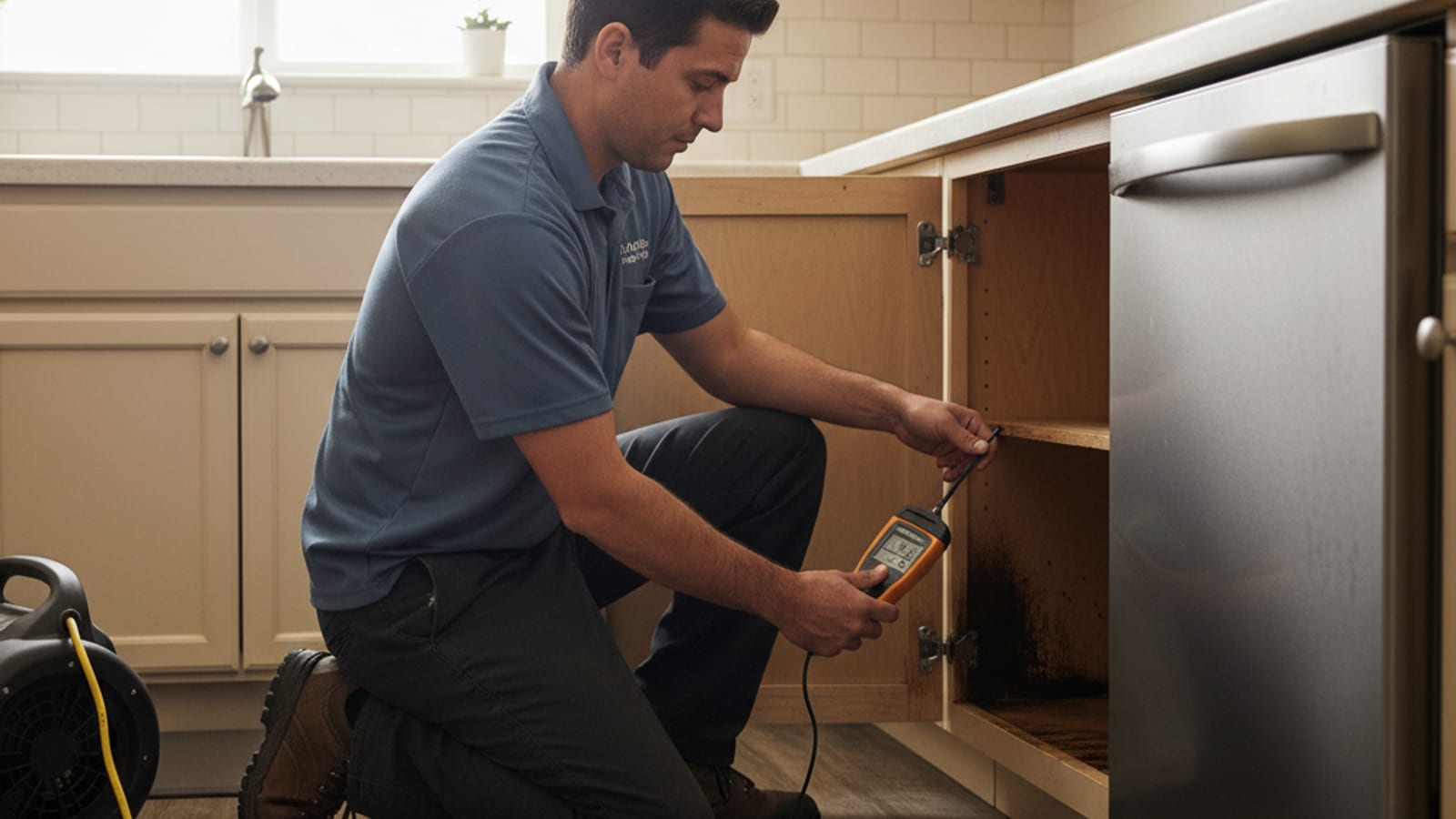
The leak you notice on the kitchen floor is often the last place the water went. It usually sat in the cabinet base and under the dishwasher first.
Restore Pro SD matches you with a licensed independent restoration professional. We do not send a brand crew. The customer contracts with that professional.
Direct answers
Stop the water. Close the angle stop under the sink that feeds the dishwasher, clockwise. If that valve will not turn, shut the house main.
Cut power. Trip the dishwasher breaker, or unplug it if you can do that without standing in water. If outlets or cords are in water, do not stand in it. Turn the main breaker off only if you can reach it dry. Otherwise call an electrician.
Then look under the cabinets. Pull wet items out of the adjacent bases. Photograph the leak source, the cabinet floor, and any staining before you mop.
Who dries it? An independent restoration professional. EPA guidance is to fix plumbing leaks as soon as possible and dry items completely. If the water sat in particleboard, ask that professional how they will handle the cabinet base. Sewage or other contaminated water is a different job.
How dishwashers leak
Five common failure points, without pretending we have a county-wide count:
- Door gasket. Spray out the front during a cycle, down the kickplate.
- Supply line. The braided hot-water line from under the sink. This is the high-pressure line.
- Drain hose. A crack or a pop-off at the disposal during drain.
- Pump or motor seal. Water from the bottom of the unit.
- Float switch. Overfill out the door if the switch sticks.
You do not need to name the failed part before you shut the valve. Stop the water first.
What to do in the first minutes
- Shut the dishwasher supply valve, then power.
- Open the cabinets beside the unit and check the base for standing water.
- Photograph wide and close before you throw towels on it.
- Do not run a box fan into a soaked cabinet as the whole plan.
Then call. Hidden wet particleboard does not announce itself with a puddle.
Where the water tends to go
From the unit, water usually hits the cabinet base, then the subfloor, then the wall behind the unit, then shared bases next door. Floor finish at the kickplate is often the last surface you see.
Ask the independent professional to check those hidden planes, not just the visible tile or vinyl. Emergency water extraction may be needed if there is standing water in the base. The rest of water damage restoration is drying and then repairs by whoever you hire for cabinets and floors.
Particleboard cabinet floors swell. Plywood sometimes dries. This page will not quote a save rate or a price. Ask the independent professional what they measured, then ask a cabinet shop what they can rebuild.
For wood floors, see save or replace hardwood.
Insurance is the policy, not this page
Photograph the cause and the damage. Call the carrier if you have a policy. What the contract covers, including the appliance itself, is a policy question.
When to call
If the cabinet base is wet, the floor feels soft, or you cannot find the shutoff, get a moisture assessment.
Call Restore Pro SD at (858) 400-4586. The line takes a recorded message. We match you with a local licensed restoration professional. They contract with you directly.
Also useful: the first 24 hours after water damage and refrigerator water line leaks.