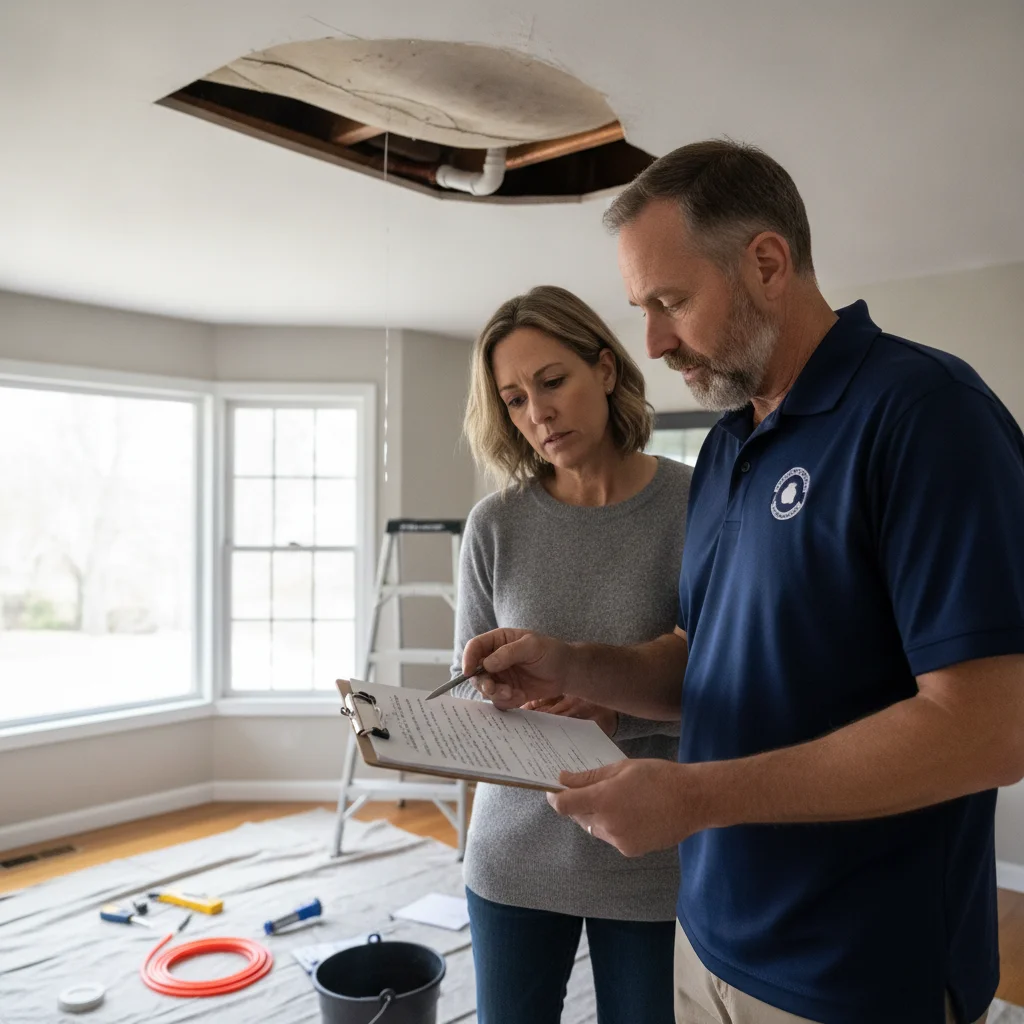
The stain on the ceiling is the last place the water showed up, not the repair. Ceiling water damage repair is the work after the assembly is dry: cut-out, replacement, texture, and paint, written as separate lines from drying. In a San Diego County house, mixing those lines is how a winter leak gets a fresh coat of paint over damp insulation.
Separate drying from ceiling repair work
A ceiling job has two phases that should not share one vague line. First the independent restoration pro contains active water where that is safe, then dries the cavity, the insulation, and the wood above the room. Rebuild of the finished ceiling is a later set of lines. If those lines are fused into “fix the ceiling,” you cannot tell whether anyone proved the assembly was dry.
Structural drying is the moisture work. Ceiling water damage repair is the rebuild that follows it. The first job can leave a stained board in place when the gypsum is still sound. The second job can cut that board out. They are not the same bid, and they should not be billed as one blurry lump.
San Diego County makes that split easy to miss. The long dry season is kind to a tired roof until the first hard winter storm drives rain into valleys, flashing, and stucco edges. Water then sits in attic insulation over a living room in Clairemont or a bedroom in El Cajon while the stain below still looks small. Coastal North County houses pick up slow moisture from marine air and older supply lines. Inland two-story homes from Escondido to Chula Vista often show a downstairs mark from an upstairs bath long after the fixture looks dry. In each case the visible mark is the end of a path, not the size of the wet area.
The EPA’s mold guidance is plain on the moisture side: fix plumbing leaks and other water problems as soon as possible, and dry items completely. That drying has to reach the back of the drywall, the joists, and any insulation that wicked water along the cavity. A board that feels dry to a palm can still hold moisture on the hidden face.
Ask the independent pro to keep drying and rebuild in separate groups of lines. Ask what will be measured, and in which rooms. Ask what happens if a reading is still high when a finish crew wants to start. Paint, texture, and new gypsum do not dry a cavity. They close it.
Compare removal, replacement, and finish items
You do not always replace a ceiling after water damage. You also should not treat a brown ring as paint-only work. The written ceiling water damage repair scope should name three different finish paths, then say which one applies after drying is done.
Removal is for material that cannot stay. Soft gypsum, crumbled face paper, a board that sags under its own weight, and insulation that stayed wet against the back of the ceiling usually come out. The independent pro should say how far the cut goes, and whether it stops at the stain or continues to solid board and framing. A small ring can hide a much larger wet patch once the cavity is open. For a closer look at that drywall choice, see when wet drywall is repaired or replaced.
Replacement is new board, fasteners into joists or backing, and a patch sized to the opening. Thickness has to match the rest of the ceiling. A mismatch shows as a ridge even after texture. In many San Diego tract homes the ceiling is knockdown or orange peel. In older pockets of North Park, Mission Hills, and parts of South Park you may be looking at plaster, not gypsum. Those are different finish lines. A scope that says only “patch ceiling” does not tell you which one you are buying.
Finish items are tape, joint compound, texture match, primer, and paint. They come last. They are also the lines people try to skip. Painting over a water-damaged ceiling is not a repair when the board is still wet or when mold is on the surface. The EPA is direct: do not paint or caulk moldy surfaces. Clean up the mold and dry the surfaces before painting. Paint applied over moldy surfaces is likely to peel. If the question is whether stain-blocking paint can stand in for cleanup, read whether you can paint over mold.
A published average cost to repair a ceiling with water damage in San Diego County could not be confirmed from the sources this site uses. Local quotes move with access, texture, how much board comes out, and whether another trade has to open the same cavity. Compare written repair estimates by line, not by a single number.
Water damage on a ceiling often shows as a yellow or brown ring, bubbling paint, a soft spot, or a seam that starts to drop. Those signs tell you water arrived. They do not tell you the repair list. That list comes after moisture work, not before it.
Ask how hidden moisture will be rechecked
The stain is a map of where water finally showed. It is a poor map of where water traveled. In a San Diego two-story house, water from an upstairs bath can run along a joist and drip several feet from the fixture. In a one-story house with an attic, soaked insulation can keep feeding the back of the drywall after the roof or pipe has already been stopped. Closing the ceiling on that hidden moisture is how the same ring comes back.
Ask who will recheck the cavity, with what, and when. A serious scope names more than “we’ll make sure it’s dry.” It should say which surfaces get readings: the remaining drywall, the joists, nearby wall tops, and any insulation left in place. It should say the ceiling stays open until those checks are written down. A water damage drying log is the paper trail for that. If the independent pro cannot explain how rechecks will be recorded, the rebuild lines are guesswork.
Ask what happens if a reading is still high after the first drying pass. The honest answer is more drying, more removal, or both. The weak answer is primer and paint on a schedule. San Diego’s marine layer along the coast and hot inland afternoons in places like El Cajon and Escondido both fight a closed, damp cavity in different ways. Coastal air keeps surfaces cool and slow to dry. Inland heat can make a room feel dry while the insulation above it is still wet. Rechecks catch that. A calendar date does not.
If you suspect the HVAC system is contaminated with mold, the EPA says to consult its duct-cleaning guidance before going further. Do not run the HVAC system if you know or suspect it is contaminated with mold. It could spread mold through the building. A ceiling stain around a vent is a reason to ask that question before anyone turns the HVAC system on to “help dry the room.”
Identify work that sits outside the repair scope
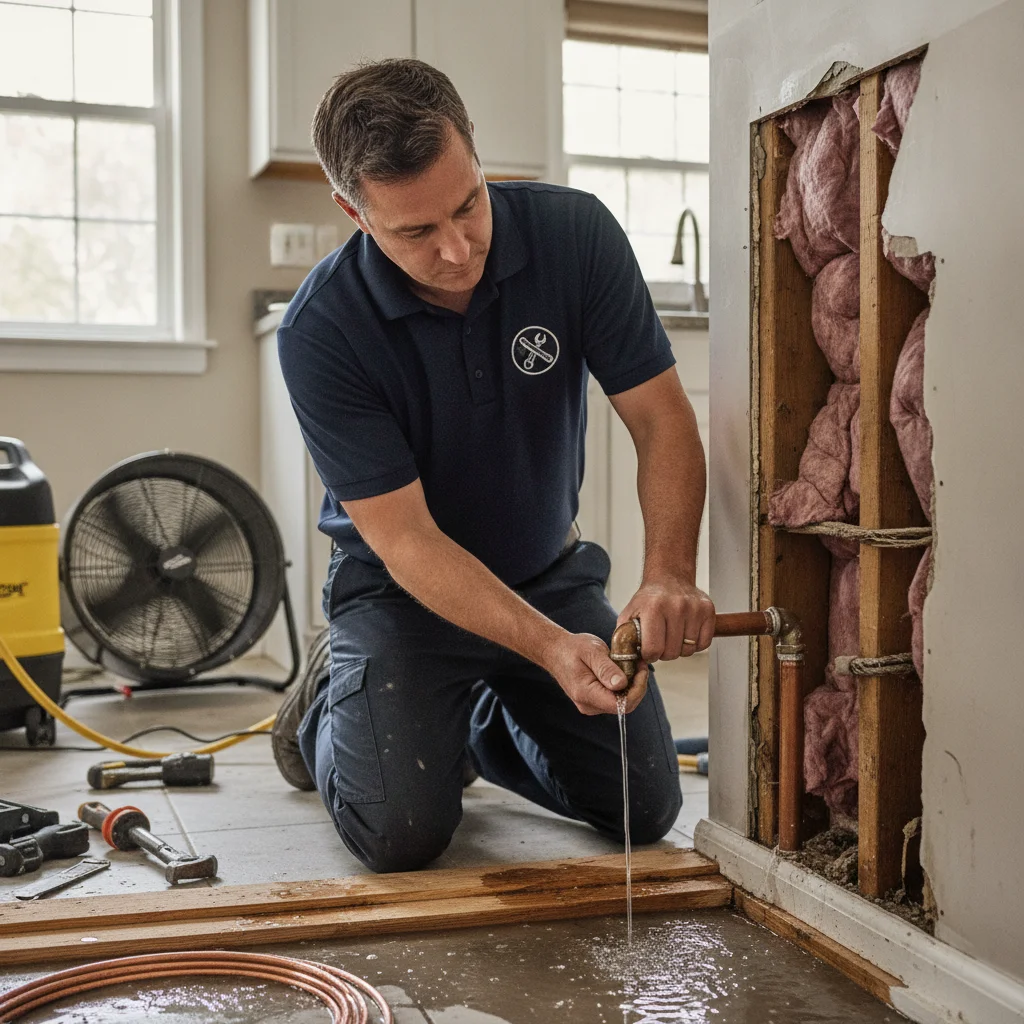
Ceiling water damage repair is the ceiling. It is not a stand-in for every trade the leak touched. A clean scope says so in writing, instead of implying one crew will handle the roof, the pipe, the wiring, and the paint.
Source work sits outside the rebuild. A roofer, a plumber, or an HVAC technician may have to stop the water before the restoration pro can finish drying. Restore Pro SD does not diagnose which of those it is. The independent restoration pro should still refuse to close a ceiling under an active leak. A repaired ceiling under an unrepaired leak is the next stain, timed for the next storm or the next shower.
Electrical work sits outside a drywall line. Can lights, fans, and junction boxes share the same cavity as a wet ceiling. If electrical circuits or equipment are wet or near water, the CDC says to turn off power at the main breaker only when it can be reached without entering standing water. Otherwise call an electrician. Never switch power on or off while standing in water. A ceiling repair scope that never mentions fixtures or a licensed electrician, when water reached a light, is incomplete.
Contaminated water sits outside a simple patch. If water or mold damage was caused by sewage or other contaminated water, the EPA says to call a professional experienced with contaminated-water damage. That is a different job from cutting out a clean supply-line stain. It may include sewage cleanup before anyone talks about texture.
Mold work can sit outside a small finish repair. The EPA says that if the moldy area is less than about 10 square feet, roughly a 3 ft by 3 ft patch, a homeowner can often handle cleanup using EPA tips. If there has been a lot of water damage, or mold growth covers more than 10 square feet, consult EPA mold remediation guidance. Allergic reactions to mold are common and can be immediate or delayed. Mold can also cause asthma attacks in people with asthma who are allergic to mold. Mold exposure can irritate the eyes, skin, nose, throat, and lungs. That is a health question for a clinician, and a cleanup question that may belong on a mold remediation scope rather than a paint line.
If you rent, California Civil Code §1941 requires the lessor, absent an agreement to the contrary, to put a building intended for human occupation into a condition fit for occupation and to repair later dilapidations that render it untenantable. Civil Code §1941.1 treats a dwelling as untenantable if it substantially lacks listed characteristics, including effective waterproofing and weather protection of the roof and exterior walls, and plumbing maintained in good working order. Civil Code §1942 is a limited repair-and-deduct path after notice, with caps and timing rules you should read on the statute, not from a blog. Tenant and landlord water damage rules in California is the local walkthrough. None of that makes Restore Pro SD a party to the lease.
Verify each independent pro before work starts
Restore Pro SD is a referral service. It matches you with licensed, independent local water damage professionals. It does not hold a Contractors State License Board license, does not employ restoration crews, and does not perform the physical work. The customer contracts and pays the professional directly. That split only helps you if you check the person who will actually open the ceiling.
Water damage restoration repair work in California is licensed by the CSLB. Before work starts, look up that independent pro on the CSLB license check. Confirm the name on the proposal matches the name on the license. Confirm the license is current. IICRC credentials such as WRT or ASD are voluntary industry certifications. They are not a California license and they do not replace a CSLB license. For a fuller checklist, use how to verify a water damage restoration company.
Ask for the ceiling water damage repair scope in writing. You want drying listed apart from demolition, replacement, texture, and paint. You want a note on who stops the source if that work is another trade. You want a note on moisture rechecks before the cavity is closed. You want a clear statement of what is not included. EPA mold and moisture guidance is worth reading before you sign a finish-only proposal over a still-damp stain.
Do that homework on every independent pro, including the one we connect you with. A license lookup takes minutes. A closed, wet ceiling takes the stain public again.
When to call us
Call when water has reached a ceiling and you need a licensed restoration pro to separate drying from the rebuild, write the cut-out and finish lines, and keep source work with the right trade. Call us at (858) 400-4586 and we’ll connect you with a licensed local restoration pro.