
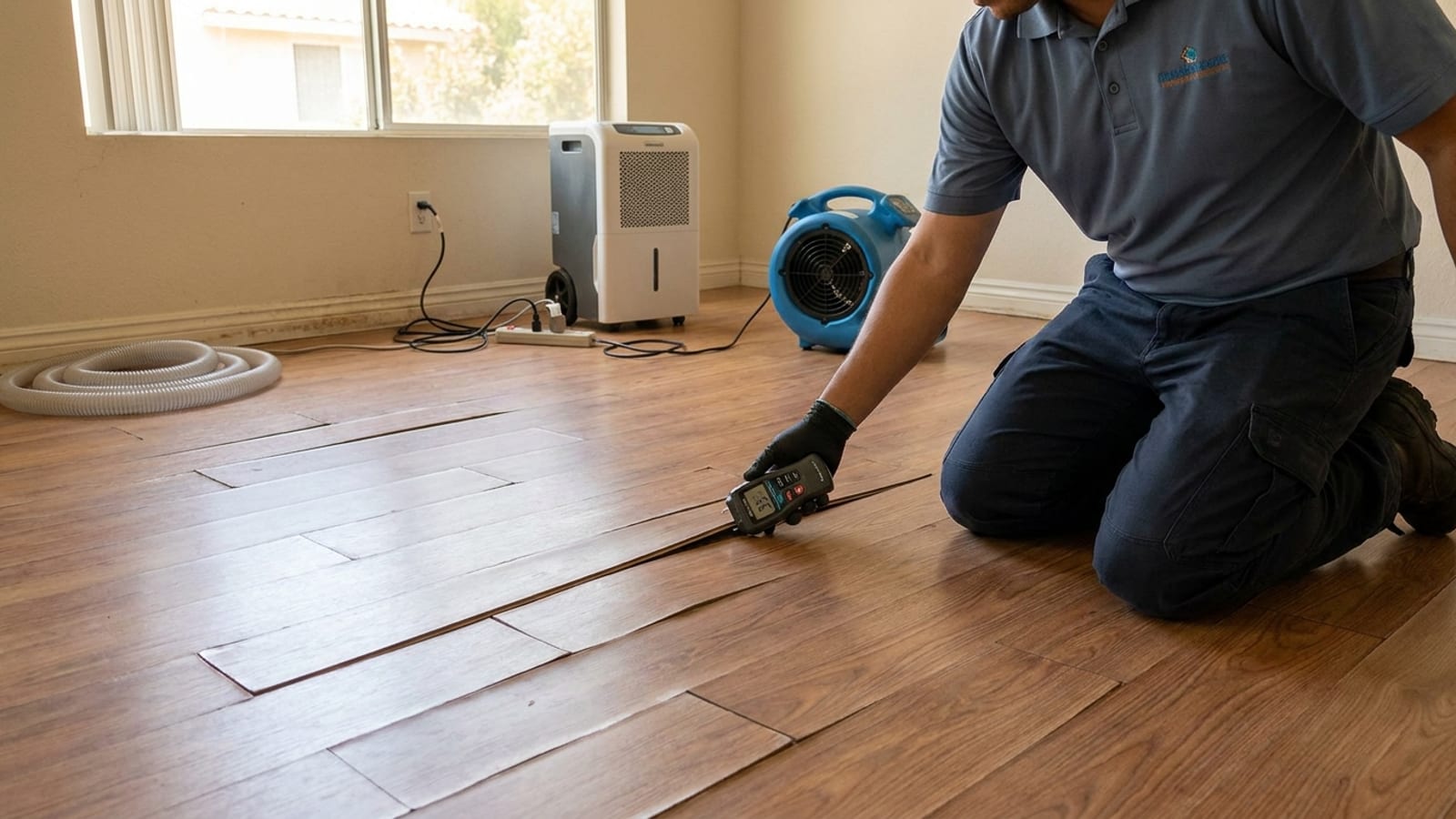
Luxury vinyl plank flooring is everywhere in San Diego homes now. It’s affordable, looks like real wood, and feels solid underfoot. Then a burst pipe or flood happens, and you’re staring at soaked vinyl. Unlike hardwood that can sometimes dry out, vinyl plank water damage almost always means replacement.
Here’s why, and what actually happens to your floor when water gets underneath.
Vinyl Plank Isn’t Like Hardwood
The single biggest difference between vinyl plank and hardwood is the core. Hardwood is solid wood: it can shrink, warp, and sometimes recover with controlled drying. Vinyl plank has a plywood or high-density fiberboard (HDF) core wrapped in vinyl layers.
Once that core gets wet, the adhesives and wood fibers absorb water and swell. The vinyl exterior is waterproof, but everything underneath isn’t. The glued edges are especially vulnerable. Water seeps into the seams, the core expands, and the whole structure fails from the inside out.
Drying that out isn’t a matter of placing fans and dehumidifiers for three days. By the time water gets deep into the core, the damage is permanent.
What Happens to Vinyl Plank When It Gets Wet
Hour 0-6: The top surface beads water because vinyl is waterproof. But if standing water sits on the floor or gets under the planks (through seams, gaps, or subfloor moisture), it travels sideways through the joints and starts wicking up into the core.
Hour 6-24: The plywood or HDF core begins absorbing moisture. The adhesive holding the vinyl to the core starts failing. You might see small bubbles or slight separation starting at the edges or seams.
Day 2-3: The core has expanded enough that the planks start cupping at the edges or lifting at the joints. The swollen core can’t fit back into the gaps it was installed into. If you try to dry it with air movers at this point, the damage is already locked in.
Day 4+: The core is fully saturated. Even if the surface looks dry, the inside is still wet. Mold starts growing in the core. The structural integrity is gone.
The hard truth: by the time a vinyl plank floor feels squishy or looks damaged, the core has been compromised for days. Replacement is almost the only option.
Why Replacement Is Different From Hardwood
With hardwood, your water damage restoration company can carefully extract moisture, run structural drying for 7-10 days, and sometimes save the boards if drying started fast enough. Hardwood is solid, and proper technique can reverse cupping.
Vinyl plank doesn’t have that recovery window. The core materials don’t dry out like solid wood. Once the plywood/HDF absorbs water, the adhesives between layers fail permanently. Trying to dry the floor in place usually just traps moisture between the vinyl and the failing core, which makes mold worse.
The fastest, safest, and most cost-effective answer is rip-and-replace.
What About Vinyl Plank Subfloor Moisture
You can salvage the vinyl if the subfloor got wet but the planks stayed dry. The subfloor moisture is a separate problem: it needs to be dried thoroughly before new flooring goes down. That’s structural drying with fans, dehumidifiers, and daily moisture readings.
But if the vinyl planks themselves absorbed water, those planks have to go.
Coastal San Diego and Vinyl Plank
San Diego’s humidity is a slow enemy for vinyl flooring. Homes near the coast or in areas with high seasonal humidity can see vinyl edges failing years after a slow leak behind a wall. Moisture migrates, the seams open up, water wicks up into the core, and suddenly large sections of your floor are unstable.
If your water damage happened in a kitchen, bathroom, or anywhere moisture could migrate under the floor, assume the damage extends further than what you can see. Vinyl planks in the room next door might already be absorbing water from below.
The Real Replacement Cost for San Diego
Vinyl plank itself is cheap: $2 to $8 per square foot for the material. But when you factor in extraction, subfloor drying, old-flooring removal, subfloor repair, and new installation, you’re looking at $8 to $15 per square foot total.
A typical San Diego living room is 250-300 square feet. That’s $2,000 to $4,500 to fully replace vinyl plank after a water loss.
Your homeowners insurance usually covers this if the damage came from a sudden loss (burst pipe, flood) rather than negligence or slow leaks. Check your deductible first. If your deductible is $1,000 and the total damage is $3,000, insurance pays $2,000 and you cover the gap out of pocket.
Should You Keep The Subfloor
Vinyl plank goes down over subfloor, underlayment, or concrete. If the subfloor (plywood or OSB) got wet, it needs to dry completely before new flooring. That’s non-negotiable.
How long does subfloor drying take. It depends on:
- How wet it got (standing water vs. damp)
- Ventilation and air movement (crawlspace vs. slab)
- Humidity levels in your home (San Diego coastal homes stay humid even in summer)
Plan on 5-10 days minimum for structural drying, with daily moisture readings to confirm the subfloor is ready.
If the subfloor damage is severe (soft spots, delamination, mold growth visible), sections might need to be cut out and replaced before new flooring.
Next Steps If Your Vinyl Plank Got Wet
Stop the water first. If it’s an active leak, shut off the supply line.
Call a water damage restoration company within 24 hours. They’ll assess how far the moisture has traveled, remove the affected vinyl, and start structural drying on the subfloor. Getting a pro in fast saves the subfloor and gives insurance a clear timeline for the loss.
Document everything with photos. Your insurance claim depends on it.
Get moisture readings before and after drying so you have proof the subfloor was restored properly. This protects you if new flooring fails in a few months. You’ve got records showing the moisture was handled correctly.
Then replace with new vinyl plank. You can install the same product, upgrade to better-quality luxury vinyl, or switch to laminate, hardwood, or carpet if you prefer.
Frequently asked questions
Can you save vinyl plank flooring after water damage?
Not really. Once the core absorbs water, the integrity fails permanently. Unlike hardwood flooring that sometimes recovers with proper drying, vinyl plank’s construction means the adhesives and core don’t bounce back. Replacement is almost always the right move.
How long does vinyl plank last after water damage?
If the vinyl absorbed water but you tried to dry it in place, the floor will feel unstable and soft within days. You might get a few weeks or months if you’re lucky, but the planks will continue to cup, separate, or buckle as the core continues to expand and contract with humidity changes. Mold in the core is likely by then too.
Is vinyl plank water damage covered by homeowners insurance?
Usually, yes, if the water came from a sudden loss like a burst pipe or exterior flood. Slow leaks, plumbing neglect, or moisture from poor ventilation typically aren’t covered. Check your policy and deductible. Most San Diego homeowners have a $500 or $1,000 deductible.
How much does it cost to replace water-damaged vinyl plank in San Diego?
Material costs $2 to $8 per square foot. Full replacement with extraction, subfloor drying, removal, and installation runs $8 to $15 per square foot. A 250-square-foot room typically costs $2,000 to $4,500 total.
Can you use a dehumidifier to save wet vinyl plank flooring?
No. A dehumidifier helps dry the subfloor and the room’s air, but it can’t reverse the damage already done to the vinyl core. If the core is waterlogged, no amount of air movement will save it. Dehumidifiers are part of the structural drying process after you’ve removed the ruined vinyl.
What happens if you don’t replace water-damaged vinyl plank?
The floor becomes a mold reservoir. The core continues to absorb and release moisture with humidity swings, gradually deteriorating. Mold spores spread through your home’s air. The planks become unstable and buckle. Eventually, someone steps through. At that point, you’re replacing it anyway, plus dealing with mold remediation costs and air quality issues. Replace it while the subfloor is still salvageable.