
TL;DR
- Solar-caused roof leaks almost always trace back to one thing: a mounting bolt or bracket that penetrated the roof deck without proper flashing.
- In California, an installer whose defective work causes a leak can be held liable under negligence or breach of the implied warranty of workmanship, separate from the panel equipment warranty.
- Workmanship warranties are often only 1 to 10 years and expire fast, so report a leak the moment you see one.
- San Diego has one of the highest rooftop solar adoption rates in the country, which means thousands of roof penetrations most homeowners never think about until a leak shows up.
- Water from a solar leak sits in the attic before it ever reaches your ceiling. By the time you see a stain, it has already been traveling for a while.
A leak that starts after solar goes on the roof almost never comes from the panels themselves. It comes from a mounting bolt, lag screw, or rail bracket that penetrated the roof deck without being flashed and sealed correctly, and in a county where SDG&E says one in four customers now generate their own power from rooftop solar, that’s a lot of new penetrations sitting on roofs that used to be solid.
Here’s how solar installations cause leaks, who actually carries the liability in California when one fails, and what to do the moment you spot water where solar equipment sits overhead. If you’re dealing with a roof leak that has nothing to do with solar, our broader guide to roof leak water damage in San Diego covers the general causes and drying process.
What causes a solar panel roof leak?
Solar panels don’t leak. The racking system that holds them down does, specifically at the point where a lag bolt or mounting foot passes through your roofing material and into the structural deck below.
Every one of those penetrations needs a properly seated flashing, a piece of metal that sits under the course of shingle or tile above it and directs water around the hole instead of into it. When an installer sets the flashing on top of the existing roofing layer instead of tucking it underneath, or skips a full bead of sealant around the mounting foot, water finds that gap the first time it rains hard enough to test it. On tile roofs, cracked or improperly lifted tiles around the mount add a second failure point that shingle roofs don’t have.
This is why a solar-caused leak often shows up months or even a year or two after installation. The seal doesn’t fail on day one. UV exposure, thermal cycling, and San Diego’s long dry stretches between storms slowly degrade a marginal seal until a real rain finally gets through it.
Who’s liable when a solar installation causes water damage in California?
The installer is. Under California law, a contractor whose defective work causes a roof leak can be held responsible under breach of contract, negligence, or breach of the implied warranty of workmanship, which is separate from whatever warranty came with the solar panels or inverter.
Most reputable installers also carry their own workmanship warranty specifically covering the penetrations and flashing work, typically running anywhere from 1 to 10 years depending on the company. That warranty is what pays for the roof repair and, in many cases, the water damage cleanup that follows. The catch is that these warranties expire fast, and if you sit on a leak for months before reporting it, you can miss the window entirely, especially on a 1-year workmanship term.
Two things make or break a claim against the installer: showing the work was defective, and connecting that defect directly to the damage. That’s exactly the kind of documentation a restoration crew builds as a normal part of the job, moisture readings, photos of the penetration point, and a clear record of when the leak was first noticed. We hand that record to you and your insurer at (858) 400-4586, whether the fault turns out to be the installer’s or not.
How do I know if my roof leak is coming from my solar panels?
Look for the pattern first. A solar-caused leak almost always shows up directly under the array footprint or along the rail lines, not randomly across the ceiling. If the stain lines up with where the panels sit overhead, or it started sometime after an install or a re-racking service call, solar penetrations are the first place to check.
The other tell is timing. A leak that appears for the first time during the season’s first hard rain, on a roof that was fine for years before solar went in, points straight at a mounting-point failure rather than general roof aging.
Either way, don’t wait to find out for certain before calling someone. The installer can confirm the source. We can start water damage restoration the same day, regardless of whose flashing is at fault.
What does a solar-panel roof leak do to your attic and ceiling?
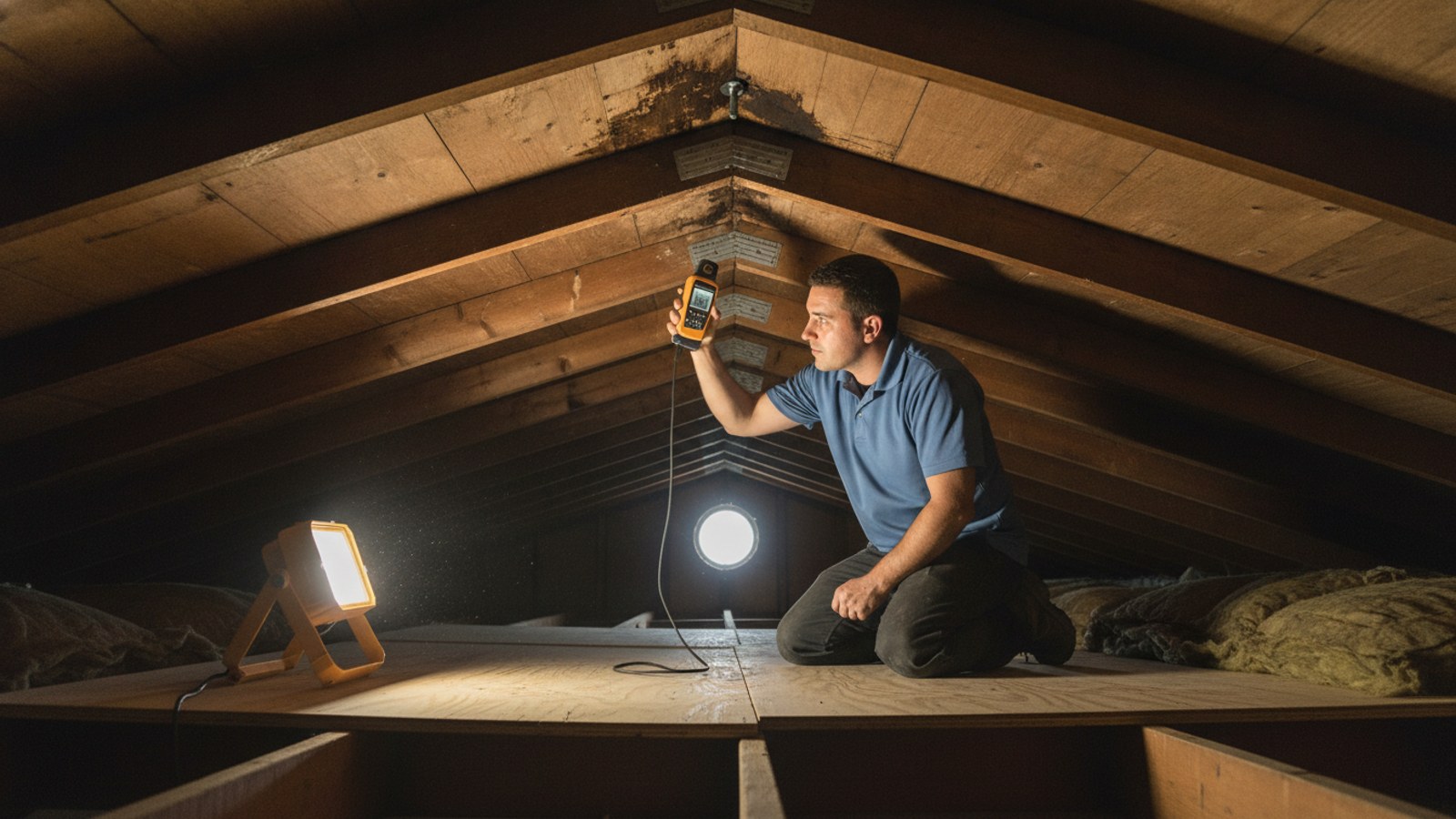
It starts in the attic, not the ceiling, and that’s the part most homeowners miss. Water enters at the penetration, runs across the top of the roof decking, and soaks into whatever attic insulation sits beneath the array before it ever reaches drywall. By the time a stain appears on your ceiling, the insulation above it has usually been wet for a while.
From there, the path is the same as any other ceiling water damage case. Water travels along ceiling joists, sometimes several feet from the actual entry point, before finding a seam to drip through. Once it’s in the ceiling drywall, it moves into the wall cavities below, soaking framing and insulation on its way down. Solar arrays typically cover a large section of roof, so the wet zone in the attic is often wider than a single pinhole penetration would suggest.
Left alone, wet insulation and framing inside a closed cavity don’t dry on their own. The IICRC S500 standard puts the window before mold growth becomes likely in wet material at 24 to 48 hours, and San Diego’s mild year-round temperatures don’t slow that clock down the way a cold winter would elsewhere. That’s the standard we follow for every structural drying job. You can read more about that window in our guide to what happens in the first 24 hours after any water intrusion.
How fast do you need to act on a solar roof leak?
Within the day you notice it. Every hour water sits in an attic or ceiling cavity, the damage compounds, and a solar array on top of the roof makes the affected section harder to access and dry quickly. We aim to be on site within 60 to 90 minutes anywhere in San Diego County.
What to do first if you find a solar panel roof leak
- Photograph the stain and, if you can safely access it, the attic below the array. This is your record of when the leak was first noticed, which matters for both the installer’s warranty and your insurance claim.
- Contact the solar installer and a roofer. The installer needs to know a mounting point may have failed. If the installer is unresponsive or out of business, a roofer can still assess and temporarily seal the penetration.
- Call a restoration crew for extraction and moisture mapping. We map how far the water traveled in the attic and ceiling before drying starts, which is the same documentation that supports a workmanship warranty claim or an insurance claim.
- Check when the system was installed. If it’s within the workmanship warranty window, most installers cover the repair and often the resulting water damage. Report it in writing the same day you find it.
- Notify your homeowners insurer. Coverage often depends on whether the loss reads as sudden (typically covered) or as long-term seepage from a known bad seal (often excluded). See our guide on what homeowners insurance covers for water damage for how that distinction usually plays out.
San Diego’s solar roof leak risk factors
San Diego carries more of this risk than most of the country, for two reasons that pull in opposite directions.
First, California’s Title 24 building code has required solar on nearly all new single-family homes and low-rise multi-family construction since January 1, 2020. Newer developments across the county have solar installed at construction, on fresh roofing, by the builder’s crew. Fewer years of UV exposure means fewer degraded seals so far, but any flashing mistake made at that first install is still sitting there waiting for a hard enough rain.
Second, and bigger in raw numbers, is the retrofit wave. SDG&E reports more than 350,000 residential customers, over one in four, now have rooftop solar, and the large majority of those systems went onto roofs that were already 10, 20, or 30 years old. Older tract-home stock across inland communities like Poway, Santee, El Cajon, and Rancho Bernardo often has original or once-replaced tile and composition roofing. Drilling new mounting points into decking that’s already brittle from decades of San Diego sun raises the odds that a flashing detail gets missed or a tile cracks during install.
Both risks share the same trigger: San Diego’s long dry season means a marginal seal can sit untested for months before the first real atmospheric-river storm finally finds it. That’s usually the moment homeowners discover the problem, and by then the attic has often been wet for hours before anyone notices.
Frequently asked questions
Do solar panels void my roof warranty?
Not automatically, but they can if the installation wasn’t done by a licensed, insured contractor following manufacturer specifications. Many roofing manufacturers require specific penetration and flashing methods to keep the roof’s own warranty intact, so it’s worth confirming your roofer’s warranty is still active after a solar install.
Is the solar company responsible for a roof leak?
Generally, yes, if the leak traces back to their installation work. California law allows a contractor to be held liable for negligence or breach of the implied warranty of workmanship when defective penetration or flashing work causes water damage. This is separate from the equipment warranty on the panels themselves.
How long do I have to report a solar-caused leak?
As soon as you notice it. Workmanship warranties on solar installations commonly run 1 to 10 years, and some are as short as 1 year. Waiting to report a leak risks missing that window entirely, along with making it harder to prove the water damage traces back to the original install rather than something else.
Can water damage from a solar leak be hidden in the attic?
Yes, and that’s the most common way these leaks go unnoticed for a long time. Water enters at the mounting point and soaks attic insulation and decking before it ever shows up as a ceiling stain. If you know solar work was done recently, it’s worth having the attic checked even without a visible stain yet.
Does homeowners insurance cover solar panel roof leaks?
It depends on how the loss reads. A sudden failure is typically covered under most policies. Damage from a seal that was slowly failing for months or years, sometimes called gradual seepage, is often excluded. Documentation of when the leak first appeared matters a great deal here.
How fast should restoration start after a solar roof leak?
The same day you find it. Standing water and saturated insulation in an attic only get more expensive to fix the longer they sit, and mold risk starts within 24 to 48 hours in San Diego’s climate. We coordinate with your installer or roofer so the leak gets stopped while we handle the water already inside.
The bottom line
A leak under a solar array almost always comes down to one mounting point that wasn’t flashed correctly, and in California, that puts real liability on the installer, not just on you. The water doesn’t wait for that liability question to get sorted out. It starts soaking your attic insulation the moment it gets past the roof deck.
At Restore Pro SD, we handle the water damage side the same day, document the source clearly enough to support a workmanship warranty claim or an insurance claim, and coordinate directly with your installer or roofer while the repair gets scheduled. We cover all of San Diego County, from Poway to the coast. Call (858) 400-4586 any hour.