
TL;DR
- Who pays for condo water damage in San Diego depends on the cause, not on which unit got wet.
- Your HO-6 unit policy covers your interior, finishes, and belongings.
- The upstairs or neighboring owner’s liability covers you when their appliance or plumbing failed.
- The HOA master policy covers common-area causes like a shared stack or a leaking roof deck.
- Whoever pays, start mitigation now. Standing water doubles the damage every hour it sits.
Water damage in a San Diego condo is more of a fight than in a single-family home, because three different insurance policies might be on the hook. The water is in your unit, but the cause might be in someone else’s. That one fact decides who pays.
Here’s how the responsibility sorts out, what your own condo policy actually covers, and where San Diego’s condo stock tends to fail.
Who pays for condo water damage in San Diego?
Who pays depends entirely on where the water came from. There are three possible payers, and the cause of loss picks the one that applies.
- Your HO-6 condo policy pays when the source is inside your unit, like your own supply line, water heater, or dishwasher. It covers your interior finishes, flooring, cabinets, and personal property.
- The upstairs or neighboring owner is responsible when their plumbing or appliance failed and sent water into your unit. Their liability coverage, or their own HO-6, handles it.
- The HOA master policy pays when the cause is a common element, like a shared plumbing stack, a roof or deck the association maintains, or a slab the HOA is responsible for.
The trap is that the unit that floods and the unit that caused it are often not the same. That’s why cause-of-loss documentation matters so much in a condo. We document the source carefully on every multi-family job, because that record is what settles who pays. Call us at (858) 400-4586 and we start water damage restoration and the paper trail at the same time.
Water is coming through my ceiling from the unit above. Who’s responsible?
If a neighbor’s unit caused the leak, they’re generally responsible for the damage to yours. Their appliance failure, their overflowed tub, their burst supply line: that’s their liability, and their policy should respond.
There are two catches. First, “responsible” and “paid quickly” are different things. Liability claims between owners can drag, especially when the upstairs owner disputes the cause. Second, negligence usually has to be shown. If the upstairs owner did nothing wrong and a truly sudden failure happened, your own HO-6 may end up covering your interior while the two carriers work it out.
Either way, the answer is the same on day one. Don’t wait for the neighbors or the adjusters. Get the water out and get it documented. We handle emergency water extraction and full cause-of-loss photos before anything gets torn out or dried.
What your HO-6 condo policy actually covers
An HO-6 is the unit owner’s policy, and it’s built to fill the gap the master policy leaves. In most San Diego condos, the master policy stops at the studs or the drywall, and everything on your side of that line is yours to insure.
Your HO-6 typically covers:
- Interior finishes and betterments, meaning your flooring, cabinets, countertops, paint, and any upgrades you installed.
- Personal property, your furniture, electronics, and belongings.
- Loss assessment coverage, which covers your share of a cost the HOA passes back to all owners, including a master-policy deductible.
That last one is the piece most owners miss. If the association’s master policy has a large deductible and the board splits it across the owners, loss assessment coverage on your HO-6 is what pays your share. Default limits are often low, so it’s worth asking your agent to raise it.
When the HOA master policy pays (and the deductible trap)
The master policy covers the building’s common elements. If the cause is a shared plumbing stack, a roof the HOA maintains, a common-area supply line, or a waterproofing membrane on a shared deck, that’s a master-policy claim.
The trap is the deductible. Condo master-policy deductibles in San Diego commonly run $5,000 to $25,000, and some run higher. On a smaller loss, the deductible can exceed the whole repair bill, which pushes the cost back onto the owners even though the master policy technically “covers” it. Many CC&Rs let the board assess that deductible to the owner whose unit was involved.
Read your CC&Rs before you assume the HOA is paying. The document spells out where the master policy’s responsibility ends and yours begins, and whether the deductible lands on you. We coordinate with property managers and HOA boards on multi-family losses and give the board clean documentation for the master-policy claim.
San Diego’s condo water damage hot spots
Condo losses in San Diego cluster in a few predictable places, and knowing the building era tells us what failed.
Downtown and uptown high-rises take losses on commercial domestic-water risers, the vertical supply lines that feed stacked units. When a riser or a shared stack fails, water travels down through several units at once, and it’s almost always a master-policy question.
The condo conversions along corridors like El Cajon Boulevard, India Street, and the Cortez Hill area are older buildings with newer interiors. Rooftop deck and balcony waterproofing failures on these are a steady source of ceiling leaks into the units below. The Coronado Cays and the coastal condo stock in Pacific Beach and Mission Valley see the same deck-membrane failures, made worse by salt air and marine-layer humidity.
That humidity is why mold moves fast in a San Diego condo. Water trapped in a shared wall cavity between units can colonize within 24 to 48 hours. If a leak sat before anyone noticed, we run mold remediation on the affected assemblies, not just a dry-out. You can read more in our guide to what to do in the first 24 hours.
What to do in the first hour
The insurance question can wait an hour. The water can’t. Every hour standing water sits, the damage roughly doubles, and mold gets a head start.
- Stop the source if you safely can. Shut your unit’s water at the valve, or call the property manager for the building shutoff on a common-area failure.
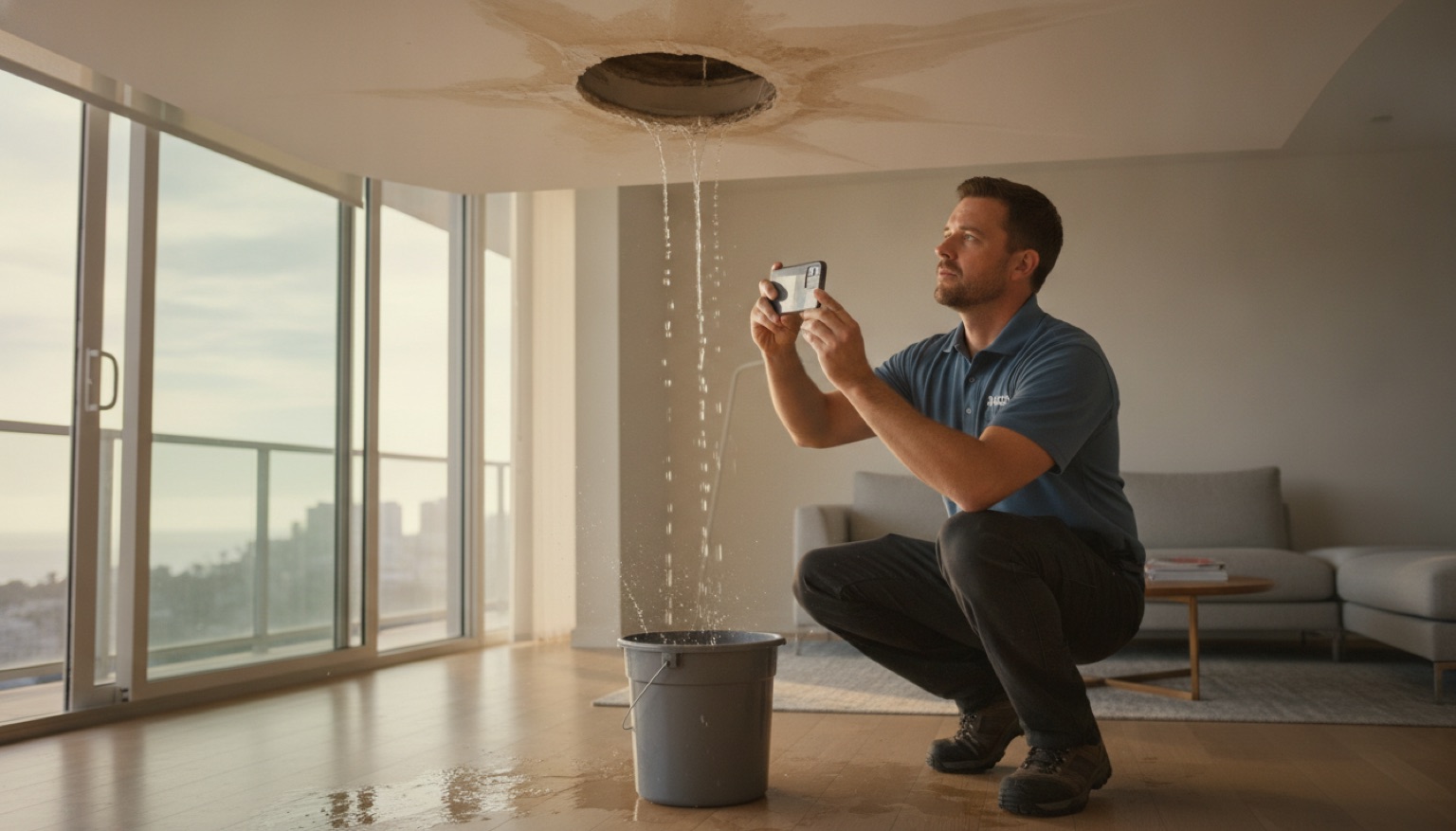
- Document everything before you touch it. Photograph the water, the source, the ceiling, and the damaged belongings. This is your cause-of-loss record for whichever policy responds.
- Get standing water out. Mop, towel, or shop-vac what you safely can while help is on the way.
- Call a restoration crew, then your carrier. Insurers expect prompt mitigation to prevent secondary damage. Waiting for an adjuster before you start drying can actually work against your claim.
- Notify the HOA and the upstairs owner in writing. A dated notice protects you if liability becomes a dispute.
For the full sequence and the mistakes that sink claims, see our water damage insurance claim process and does homeowners insurance cover water damage.
Frequently asked questions
Who pays for water damage in a San Diego condo?
It depends on the cause. Damage from a source inside your unit falls to your HO-6 policy. Damage caused by a neighbor’s plumbing or appliance is their responsibility. Damage from a common element like a shared stack or an HOA-maintained roof is a master-policy claim. The cause of loss, not the location of the water, decides the payer.
The unit above me flooded my ceiling. Do I pay or do they?
Generally the upstairs owner is responsible when their plumbing or appliance failed. Their liability coverage or HO-6 should respond. If the failure was truly sudden and no negligence is shown, your own HO-6 may cover your interior while the carriers sort out reimbursement. Start mitigation immediately either way.
What does my HO-6 condo policy cover for water damage?
Your HO-6 covers your interior finishes, flooring, cabinets, upgrades, and personal property, plus loss assessment coverage for your share of any cost the HOA passes back to owners. The master policy usually stops at the drywall or studs, and your HO-6 covers everything on your side of that line.
Will the HOA master policy pay for my water damage?
Only when the cause is a common element the HOA maintains, and only above the master-policy deductible. Those deductibles commonly run $5,000 to $25,000 in San Diego, and many CC&Rs let the board assess that amount back to the owner whose unit was involved. Read your CC&Rs before assuming the HOA covers it.
How fast do I need to act on condo water damage?
Within the hour. Standing water roughly doubles the damage every hour it sits, and mold can colonize a shared wall cavity within 24 to 48 hours in San Diego’s humidity. Document the loss, then get the water out. We aim for 60 to 90 minutes anywhere in San Diego County, day or night.
Do you coordinate with property managers and HOA boards?
Yes. Multi-family and condo losses are a regular part of our San Diego work. We handle building access, resident notification, containment when a loss spans units, and clean cause-of-loss documentation for the master-policy claim. Coordinating with the board early keeps the claim moving.
The bottom line
In a San Diego condo, the water lands in one unit but the bill can land on three different policies. Your HO-6 covers your interior, the neighbor’s liability covers their failures, and the master policy covers the common elements. The cause of loss decides which one pays, so documenting the source is half the battle.
Whoever ends up paying, the first hour is the same. Get the water out and get it on record. At Restore Pro SD, we run water damage restoration and the documentation together, coordinate with your HOA and property manager, and cover all of San Diego County, from the downtown high-rises to the Coronado Cays. Call (858) 400-4586 any hour.