
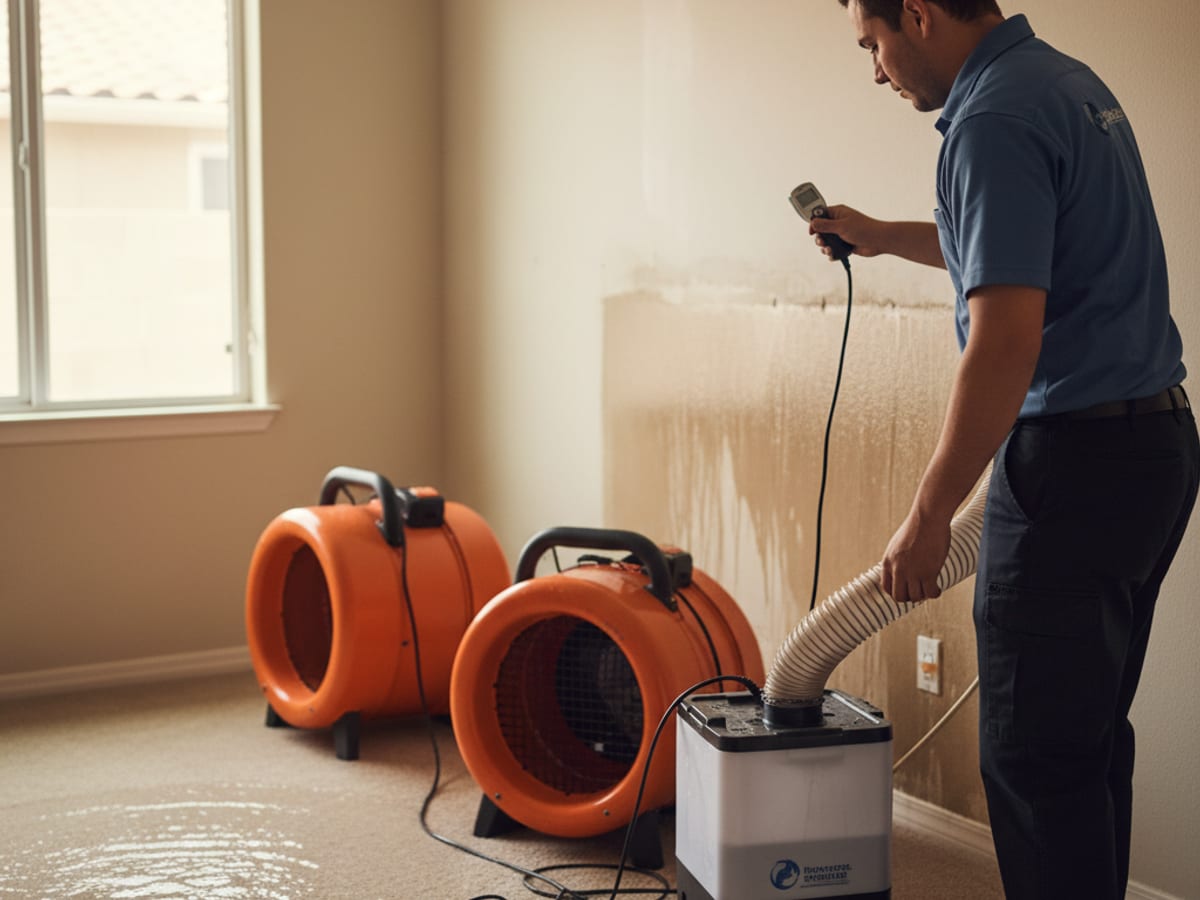
When a roof leak finds an attic, the damage spreads fast. Wood framing absorbs moisture, insulation loses R-value, and mold settles into the darkness. By the time a homeowner notices a stain on the ceiling below, the cavity behind it may already be soft.
Attic water damage in San Diego isn’t just a roof problem. It’s structural, insulation, and mold converging in a space most people never see. Here’s what causes it, how to catch it, and what it costs to fix.
What Causes Attic Water Damage
San Diego’s climate tests roofs hard. Wind-driven rain, atmospheric rivers, salt air corrosion, and sun-baked sealants that crack. Gutters get clogged. Flashing fails at the ridge, valleys, and chimneys. When the roof membrane gives way, water runs straight into the attic.
Roof flashing failure is the top cause. Flashing sits where the roof meets a vertical surface (chimney, vent, skylight) or at a valley where two roof planes meet. Sealant cracks from UV exposure, fasteners back out, and gaps let wind-driven rain slip behind the roofing. During a storm, water soaks the felt, runs along framing, and collects on the attic floor.
Ice damming happens in San Diego’s inland valleys and mountains during freeze-thaw cycles. If a roof stays warm inside from an uninsulated attic, snow melts, then refreezes at the cold overhang. The dam backs water up under the shingles and into the attic framing.
Gutter overflow sheds water directly onto the fascia. Water runs behind the guttering, into the attic vent, and soaks the framing around the perimeter. In heavy rain, the gutter itself can fail.
Roof-to-wall sealing failure lets water travel down the wall cavity and into the attic rim band. Most common where second-story walls meet the roof.
Vent pipe failure happens as boots and flashing age and crack. Plumbing vents, furnace vents, and AC condensate lines all penetrate the roof with gaskets that harden and separate.
Condensation and humidity can also wet an attic if moisture-laden air from below rises into cold roof space. It collects on rafters, insulation, and sheathing, promoting rot and mold without a visible leak.
Early Warning Signs
Most homeowners find water damage by accident. But if you go into your attic, watch for:
Visible water staining on framing or sheathing (fresh stains are tan or brown; old stains are gray), wet insulation that clumps and loses loft, mold growth on rafters or the roof deck, rust stains on metal fasteners, a musty smell, or soft spots in the wood when you press it.
If you find any of these, get a professional assessment. Early action stops mold and prevents structural compromise.
How Fast Does Attic Damage Progress
Mold can colonize damp wood in 24 to 48 hours. Structural rot advances over weeks to months. But the timeline depends on how wet the attic stays.
A single rain event that wets framing but dries within a few days may cause no lasting damage if humidity stays low and airflow is good. But an ongoing leak (like failed flashing that leaks during every rain) or poor ventilation speeds damage.
Days 1-2: Moisture saturates the framing and insulation. Spore germination begins. Days 3-7: Visible mold may appear. Wood begins to soften. Weeks 2-4: Wood rot advances. Mold spreads. Months 1-6: Structural framing weakens.
The sooner you stop the leak and dry the attic, the less damage happens.
Restoration Costs in San Diego
Attic restoration has three parts: stop the leak (roofing), remove damaged material and dry the space (mitigation), and replace what’s soft (rebuild).
Roof repair: $500 to $3,500 depending on the flashing location. Chimney flashing: $800-$1,500. Valley or vent flashing: $400-$1,000. Spot shingles: $200-$500.
Mitigation drying: $1,500 to $5,000 depending on attic size and moisture depth. Labor runs 3-7 days with daily moisture readings and verification.
Demo and rebuild: Insulation removal and replacement runs $0.50 to $1.50 per sq ft. A 1,200 sq ft attic: $1,000 to $2,500. Replacing rotten framing: $1,000 to $5,000+ depending on extent.
Insurance coverage: Most policies cover sudden roof failures and water damage. Slow leaks and pre-existing mold usually aren’t covered. Your deductible (typically $500-$2,000) applies to the roof repair.
Cash price (uninsured): $3,500 to $12,000+ depending on severity and how much framing needs replacing.
Can You DIY Attic Cleanup
No. Wet attics with mold require protective equipment to avoid inhaling spores. You can’t eyeball wood rot or verify drying to standard without professional equipment. Improper venting can spread mold spores. And re-insulation must meet San Diego code requirements for your climate zone. This requires a professional water damage restoration service.
What to Do If You Find Water Damage
-
Find the source. Is water coming from the roof or is it condensation? Look for the highest point on framing where water pools.
-
Stop active water entry. If it’s raining and water is running in, block it temporarily with buckets or towels. Call a roofer for an emergency patch.
-
Document everything with photos. This is evidence for your insurance claim.
-
Call a restoration professional. Get a free inspection and estimate.
-
Notify your insurance carrier if it’s an insured loss. Provide photos and the restoration estimate.
-
Start drying as soon as possible. Every day that passes increases mold risk and structural damage.
Attic water damage gets worse the longer you wait. Catch it early, get it dried, fix the roof. The water damage restoration process is proven to prevent mold and structural failure.
Frequently Asked Questions
How often do attic leaks happen in San Diego?
Roof leaks happen to about 15% of homes over a 20-year period in coastal San Diego due to wind-driven rain and salt air. Inland and mountain areas see different frequencies based on freeze-thaw damage and snow load.
Can I patch the roof and skip mitigation?
No. Stopping the leak prevents new damage, but existing moisture in the framing must be removed or it rots and molds. A roofer fixes the source. A restoration company fixes the damage.
Will homeowners insurance cover attic water damage?
Homeowners policies typically cover sudden water entry from failed flashing or storm damage. Your roofing deductible applies to the repair. The mitigation and rebuild may be covered under your standard deductible, depending on your policy. Check with your carrier.
How do I prevent attic leaks?
Inspect your roof twice a year. Look for damaged shingles, sealant cracks around flashings, and curled shingles. Clean gutters after leaves fall. Keep soffit and ridge vents clear. Trim overhanging tree branches. After heavy rain, check your attic for water intrusion. If you spot a problem early, emergency water extraction can prevent structural damage.
Can wet insulation be dried and reused?
Fiberglass insulation when saturated loses value and takes weeks to dry. If it’s been wet more than 24-48 hours with visible mold, remove it. Cellulose should be removed because it molds easily. New insulation is cheaper than the cost of hidden mold and rot.
How long does restoration take?
Mitigation drying: 3 to 7 days. Demo and rebuild: 3 to 10 days. Total: plan on 1 to 3 weeks from start of mitigation to completion. See how long water damage restoration takes for more detail on the full timeline.