Wastewater coming up a La Mesa toilet, shower, or floor drain is contaminated. Keep people and pets out of those rooms, and treat every wet finish as dirty until a licensed restoration pro maps the loss. East County heat on mid-century laterals along La Mesa Blvd, University Avenue, and the I-8 corridor makes a backup a source-and-contamination job, not a mop-and-fan afternoon.
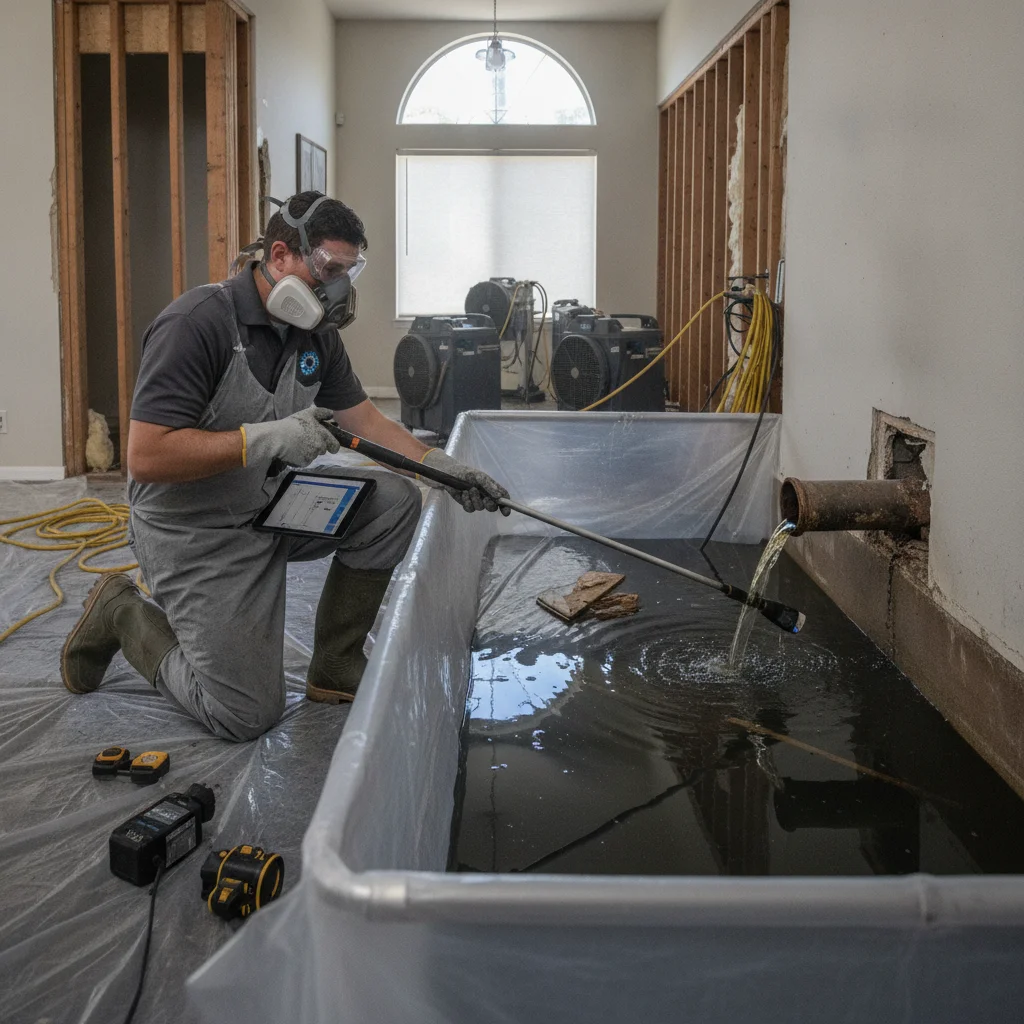
Identify the backup source and affected rooms
Start with what you can see from a dry doorway. Note which fixture failed first: a toilet, a tub, a floor drain, a downstairs shower, or a laundry standpipe. One gurgling fixture often points to a clogged trap or a blocked private line. Two or more fixtures reacting at once, especially on the lowest floor of a Fletcher Hills split-level or a La Mesa Village walk-up, often means the stoppage sits farther down the waste line.
Write down every wet room. Bathrooms, hall carpet, a garage floor drain, and the first few feet of an adjoining bedroom all count. Photograph standing water, stained baseboards, and the path toward clean rooms, from a place you can stand without stepping in the spill. Do not walk sewage onto dry flooring. Shoes and pets move it farther than the original puddle.
Stay out of the standing water if power is nearby. The CDC electrical-hazard guidance is plain: turn power off at the main breaker only when you can reach it without entering standing water. Never switch power on or off while you are standing in water. If the panel sits across a wet garage or a flooded hall, leave it and call an electrician.
If you rent, tell the owner or manager as soon as you can. California Civil Code 1941 requires a lessor, absent an agreement to the contrary, to keep a dwelling fit for occupation. Civil Code 1941.1 treats a dwelling as untenantable when it substantially lacks plumbing in good working order, among other listed items. Civil Code 1942 describes a limited repair-and-deduct path after notice, with a twice-in-12-months cap. Those statutes set habitability duties. They do not, on their own, say who pays for sewage cleanup. Tenants and owners in La Mesa can read the same statutes in our rental water-damage guide.
A hillside house off Jackson Drive or Mount Helix can hide the same backup in a lower bath while the upstairs still looks dry. A Grossmont-area ranch can push wastewater under a slab-on-grade hall. Map rooms first. The matched pro still has to confirm the source with a plumber. Cleanup of finishes and repair of the line are connected jobs, and they are not the same trade.
How contamination changes the cleanup scope
A clean supply-line leak and a sewage backup are different losses. The EPA tells homeowners to fix water problems quickly, dry items completely, and call a professional experienced with contaminated-water damage when sewage or other contaminated water caused the loss. That is the rule that changes the scope in a La Mesa home.
Household mops, shop vacuums, and box fans are the wrong tools here. A fan aimed at a toilet overflow can move droplets into a hallway, a return grill, or a child’s bedroom. If you already ran a fan, tell the matched pro. They need that when they set containment. The EPA also warns against running HVAC when you know or suspect the system is contaminated with mold, because it can spread mold through the building. Until the spill is contained and the air path is checked, leave the system off in the affected zone if you can do that from a dry switch.
Porous goods that sat in sewage are the next fork. Carpet cushion, pad, wet drywall paper, insulation, and many composite cabinets soak up the waste. Hard, sealed surfaces can often be cleaned in place once bulk waste is gone. The EPA’s mold notes are useful later in the job: a moldy patch under about 10 square feet is, in most cases, something a homeowner can handle with EPA tips, and larger growth belongs with remediation guidance. Do not paint or caulk over mold. Paint over mold is likely to peel. Sewage cleanup still comes first. Drying and any mold remediation come after the waste is out and the remaining surfaces are cleaned.
Odor is a clue, not a product choice. A sewer smell with no visible water still needs a source check, because a dry trap or a cracked waste line can load a bath long before a floor looks wet. An ozone machine is a poor stand-in for cleaning. The EPA’s review of ozone generators sold as air cleaners found little potential to remove indoor contaminants at concentrations that stay within public health standards, and ozone can be harmful. Ask the matched pro how they will clean, then dry. Masking a smell leaves the residue.
People often ask whether they can stay in the house. Keep everyone, including pets, out of the affected rooms. Eating, sleeping, or playing next to standing sewage is a bad plan. How much of the rest of the house you can use depends on where the water went, whether air moved, and who lives there. That is a judgment for you, a clinician if someone is ill, and the cleanup pro on site. It is not a promise this page can make.
Check materials beyond the visible spill
The puddle is the easy part. Sewage follows grout lines, the paper face of drywall, the bottom plate of a wall, and the seam under vinyl plank. In a 1950s or 1960s La Mesa tract near Grossmont Center, that often means a thin slab, carpet over pad, and baseboard that wicked a few inches up. On a Mount Helix or Fletcher Hills split, it can mean a lower-level bath, a storage closet, and a stair stringer that looks dry from above.
Press a fingertip only on a dry, clean edge of trim, never into the waste. Look for dark lines at the bottom of drywall, swelling of MDF base, cupping at a hallway transition, and a tacky film on vinyl. Open an unaffected closet and compare. If the hall carpet is wet, the pad under it is wet. Pad that contacted sewage is rarely a keep. That is why a small bathroom overflow can still take hallway carpet and a slice of drywall.
Cabinets and toe-kicks hide splash. A downstairs laundry on Baltimore Drive or a kitchen island near a floor drain can look fine at eye level while the kick plate is stained. Insulation in a perimeter wall on a hillside lot holds moisture against the paper. Check the room next door, then the room after that. Containment fails when a “clean” route is already dirty.
Inland East County weather works against you after the spill. La Mesa sits well inside the marine layer that cools Encinitas and Oceanside. Summer rooms run warmer, and closed-up houses hold humidity against wet paper and wood. That does not set a clock on this page. It does mean hidden wet materials are worth finding on day one, before odor and mold after water damage become the second problem.
Leave contents that touched the spill in the hot zone. Do not haul wet towels through the living room to the washer. The matched pro will plan a dirty-out path, often through a garage or a patio, so clean rooms stay clean. If a ceiling is stained or starting to sag from an upstairs overflow, stay out from under it and use the same caution we outline for sagging ceilings.

Find the wastewater authority for the property
Cleanup of the house and correction of the line are separate calls. For a parcel inside the City of La Mesa, start with City of La Mesa Public Works for the public sewer collection system. Helix Water District is the water retailer for much of the city. A Helix water bill does not name the sewer operator. Confirm the agency on the city’s current Public Works sewer page, because the city limit jogs around Lake Murray, Mount Helix, Fletcher Hills, and the El Cajon edge. A house one street over can sit in a different jurisdiction.
A published after-hours sewer emergency number for La Mesa was not independently confirmed for this page. Use the contact printed on the city’s Public Works sewer page, and ask whether the stoppage is on the public main or on the private line that serves the house. This page does not state who must pay for a lateral or a main. The city will tell you how they classify the blockage once they see it.
Most addresses inside La Mesa are on the municipal collection system. A house just outside the city, in an unincorporated pocket, can sit under San Diego County instead of City of La Mesa Public Works. Confirm the wastewater agency for that parcel before you assume the city sewer desk is the right call. Keep the agency name and any work-order numbers with your invoices.
If several neighbors on a cul-de-sac off University Avenue or near the Spring Street trolley see backups at once, say so when you call the city. A shared main or a multi-unit stack behaves differently than a single clogged toilet. Hold off on running water in the house until someone has a working theory of the stoppage. Every flush adds volume to the same rooms you are trying to isolate.
Storm runoff is a separate path. Heavy rain along the I-8 and SR-125 cuts can load area drains and, on some lots, mix with a struggling lateral. Treat mixed water in the house as contaminated until the matched pro and the plumber say otherwise. FEMA’s flood pages are useful for storm flooding in general. They do not replace the city’s sewer desk for a toilet backup on a dry Tuesday.
What to ask the matched cleanup pro
Restore Pro SD matches you with a licensed, independent local restoration pro. We do not run the job, own the equipment, or hold a contractor license. The pro you are matched with does the physical sewage cleanup. Check that firm’s license on the CSLB license lookup before work starts.
Ask them to walk the same rooms you mapped, then tell you the contaminated boundary in writing. You want the wet rooms, the rooms they will contain, and the clean route they will use. Ask which porous materials they plan to remove, and which hard surfaces they believe they can clean in place. Ask how they will handle carpet, pad, drywall, insulation, and cabinet bases that contacted the waste.
Ask when drying starts. On a sewage loss, bulk waste and unsalvageable material come out, then remaining surfaces are cleaned, then structural drying begins. Drying dirty material is not cleanup. Ask how they will document moisture readings and the dry standard they are aiming for before anyone closes a wall.
Ask how they will coordinate with the plumber or the city. Replacing a hall floor before the lateral is cleared is how the same backup returns. Source repair and finish cleanup are two scopes. You should be able to see both on paper.
Skip price talk that this page cannot support. No market range for sewage cleanup in La Mesa is on our verified claims list, so we will not invent one. What you can do is compare the written scope: rooms, materials out, cleaning method, drying, and who is responsible for the line. Our sewage cleanup estimate-scope guide is the place to see those line items side by side. Do not treat a neighbor’s invoice as your number.
Ask about occupancy in the unaffected rooms, HVAC, and pets. Ask whether they work to IICRC S500 water-damage methods for contaminated water. IICRC credentials are voluntary industry certifications. They are not a California license and they do not replace CSLB. If someone in the home is ill, that is a medical question, not a restoration slogan.
A toilet-only overflow with a clear trap is a smaller cousin of this job. If that is what you actually have, our toilet overflow cleanup notes still apply: keep the zone small, and do not pretend household disinfectant undoes sewage that reached pad and drywall.
When to call us
Call when wastewater has entered a La Mesa living space, when more than one fixture is backing up, or when carpet, drywall, or a lower level took the spill. A licensed Water Damage Restoration pro handles contaminated-water cleanup. You contract with that independent pro directly. Call us at (858) 400-4586 and we’ll connect you with a licensed local restoration pro.