A failed supply line under a Scripps Ranch sink can soak rooms the same way a coastal storm soaks a beach house. The difference is the source, the inland mesa, and the City of San Diego systems around you. Cleanup starts by naming how the water entered, then leaving extraction and drying to a licensed independent restoration pro.
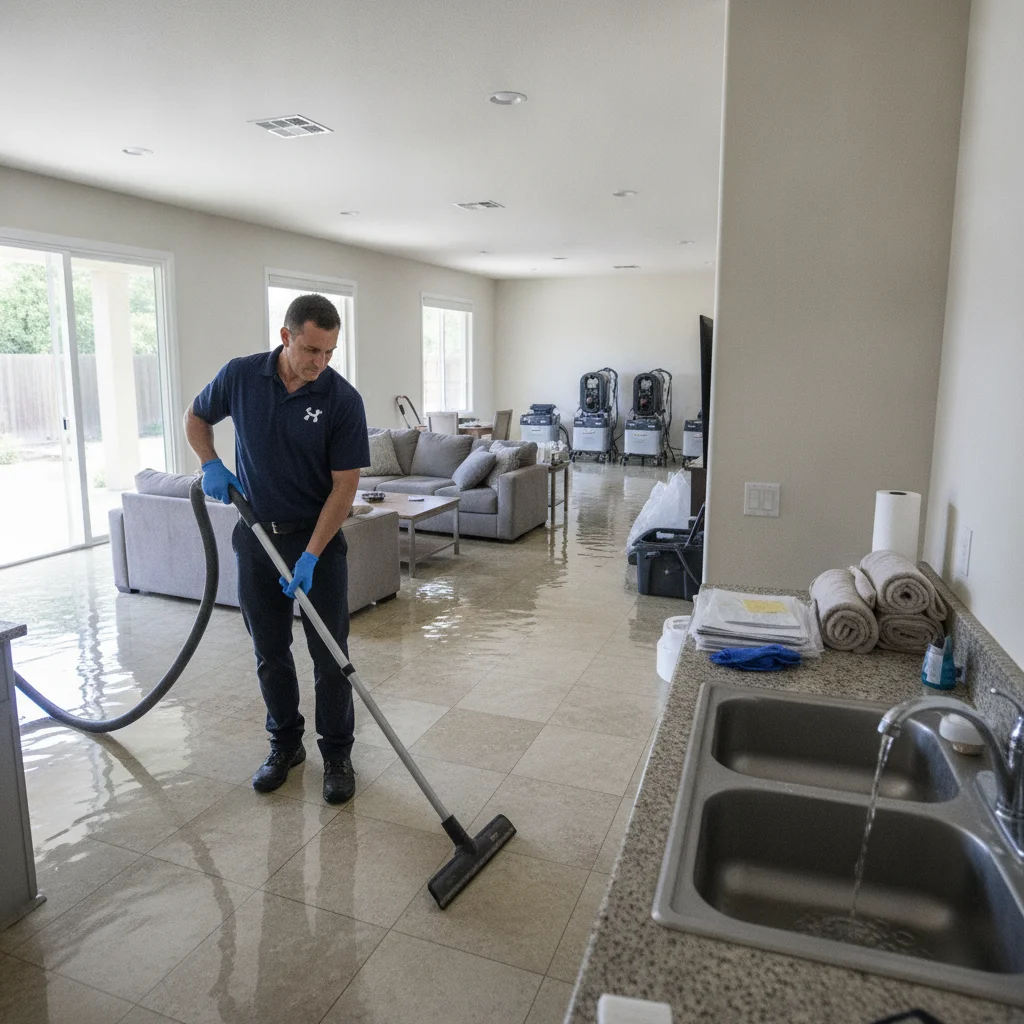
Identify how water entered the home
Water in a Scripps Ranch home usually starts inside the building, not at the ocean. Supply lines, drain lines, water heaters, and appliance hoses fail in kitchens, laundry rooms, and upstairs baths. A slab leak can wet flooring with no obvious puddle at first. Roof leaks still happen on this inland mesa when flashing or a roof penetration fails in rain. A City water-main break on a public street is a different event. That water belongs to the City of San Diego’s public system until it crosses your threshold.
Stop the source only if you can do it from dry ground. Shut the fixture valve or the house shutoff if you can reach it without walking through water. If electrical circuits or equipment are wet or near water, turn off power at the main breaker only when you can reach it without entering standing water. Otherwise call an electrician. Never switch power on or off while standing in water.
If the water is sewage or another contaminated source, cleanup is not a mop-and-fan job. The EPA’s mold and moisture guidance is clear: fix plumbing leaks and other water problems as soon as you can, dry items completely, and call a professional experienced with contaminated-water damage when sewage or other dirty water caused the loss. Household fans spread that water. They do not clean it.
Cleanup is water damage restoration work. A plumber, a roofer, or the City’s Public Utilities staff may own the source. Those trades are not the same as extraction and drying. Restore Pro SD does not send a crew, own trucks, or perform the work. We match you with a licensed independent restoration pro who does.
Name the entry point in plain words before anyone starts pulling carpet. Clean supply water, rain that entered through a failed roof, street water from a public main, and sewage are not the same job. The matched pro needs that distinction. So does your insurer. Guessing the source after the floors are already open wastes time and hides the next wet room.
Document affected rooms before cleanup starts
Photograph every wet room before furniture moves and before carpet comes up. Shoot the standing water, the baseboards, the ceilings, and the adjoining doorways. Note the time you first saw it and which fixture, wall, or exterior opening you think failed. That record is for you, your landlord if you rent, and the independent pro who later maps moisture.
Do not wade through water to stage a better photo. If the room is live with electricity, stay out and wait for a safe shutoff. Document from the doorway if that is the dry edge. A phone camera is enough. You are not building a claims file for a contractor. You are capturing what was wet before anyone disturbed it.
Walk the floor plan on paper or in a notes app. List the room where water showed first, then every room that shares a wall, a cabinet run, or a floor assembly. In a two-story Scripps Ranch house, an upstairs bath leak often shows in the ceiling below before it shows at the tub. In a slab-on-grade wing, water can travel along the slab and appear in a closet that never had a fixture.
If you rent, California Civil Code 1941 requires a landlord, absent an agreement to the contrary, to put a dwelling into a condition fit for occupation and to repair later dilapidations that render it untenantable. Civil Code 1941.1 treats a dwelling as untenantable when it substantially lacks effective waterproofing and weather protection of the roof and exterior walls, plumbing maintained in good working order, or floors maintained in good repair. Civil Code 1942 sets a limited repair-and-deduct path after notice, with caps and timing rules you should read on the statute itself before you spend rent money. Civil Code 1929 still puts ordinary-care damage on the tenant. Those rules are about habitability and notice. They are not a cleanup method.
Keep a copy of every photo off the phone that got wet. If contents are soaked, list what you moved and where it went. The matched restoration pro may later pack out items for drying. Your list keeps that work honest.
Check walls, flooring, and adjoining spaces
Visible water is the small part of Scripps Ranch water damage. Water follows the low edge of a slab, the paper face of drywall, and the pad under carpet. Check the room next door, the hallway, the garage common wall, and any cabinet toe-kick on the same run. Press gently on drywall a foot above the floor. Soft, dark, or bubbling paint is a reason to stop DIY wiping and let a pro meter the wall.
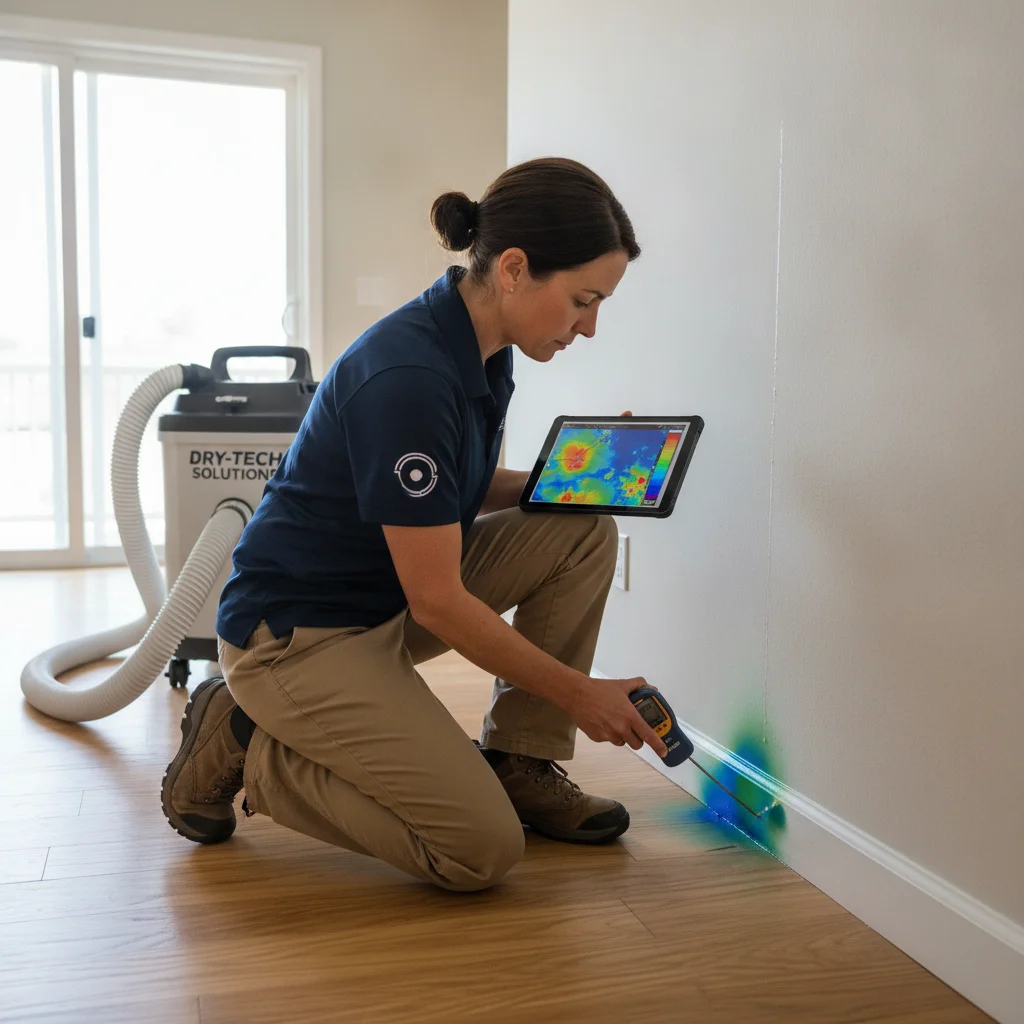
Flooring matters because each layer holds water differently. Carpet and pad stay wet after the surface looks dry. Laminate can swell at the joints. Hardwood can cup. Tile can hide water in the setting bed and the subfloor. Do not assume a dry-looking surface is dry through the assembly. The independent restoration pro maps moisture in those layers. That mapping is the difference between a surface wipe and actual drying.
If mold is already visible, size it before you scrub. The EPA says that if the moldy area is less than about 10 square feet, roughly a 3 ft by 3 ft patch, a homeowner can often handle cleanup with EPA tips. If there has been a lot of water damage, or mold covers more than 10 square feet, consult EPA mold remediation guidance and bring in a professional. Do not paint or caulk moldy surfaces. Clean and dry first. Paint over mold is likely to peel.
If you suspect the HVAC system is contaminated with mold, do not run it. The EPA warns that running a contaminated system can spread mold through the building. Consult EPA duct-cleaning guidance before you do more. Allergic reactions to mold are common and can be immediate or delayed. Mold can trigger asthma attacks in people with asthma who are allergic to it. It can irritate eyes, skin, nose, throat, and lungs in allergic and non-allergic people. That is EPA language, not a diagnosis. See a health professional for symptoms.
Adjoining spaces include the cavity behind a baseboard and the insulation in an exterior wall. Inland Scripps Ranch walls still get wet from interior leaks. They also get wet when rain finds a window pan or another exterior opening. The cleanup question is how far the moisture traveled, not how dramatic the puddle looked at 7 a.m.
Separate cleanup from source repairs
Cleanup is extraction, drying, and the removal of materials that cannot be saved. Source repair is the pipe, the roof, the window, the appliance, or the public main. Keep those jobs apart on purpose. A plumber who stops a leak has not dried the wall. A restoration pro who extracts water has not re-piped the slab. Mixing the two is how wet drywall gets closed back up.
For a private plumbing failure, the source trade is a licensed plumber. For a roof or flashing failure, it is a licensed roofing contractor. For a public main, a hydrant, or a flooded street, call the City of San Diego. The City owns that system. Restore Pro SD does not. Once the source is stopped, structural drying and flood damage cleanup belong to the restoration side. Flood damage Scripps Ranch searchers often mean indoor flooding from a main, a slab, or a backed-up drain, not a mapped river. The work is still extraction and drying after the water is off.
Do not let anyone rebuild over a wet assembly. Drywall, trim, and flooring installed on damp substrate fail later. The matched pro should show you meter readings as the structure dries, not only a pile of fans. Job length varies with how much material is wet. Structural drying often runs several days. That is a description of the work, not a promise of when someone arrives.
Check a restoration contractor’s license on the CSLB license lookup before work starts. Restore Pro SD is a referral service. We are not a licensed contractor, and we do not hold a CSLB number. The independent pro you are matched with is the one who must be licensed for the repair. IICRC credentials, when a pro holds them, are voluntary industry certifications. They are not a California license.
Contents are a third track. Furniture, documents, and textiles may need packout. That is still cleanup, not source repair. Leave it on the restoration scope so the plumber is not packing your closets.
Use Scripps Ranch details only when sources confirm them
Scripps Ranch is a neighborhood of the City of San Diego, not its own city. It sits inland in the city’s northeast, east of Interstate 15, north of Marine Corps Air Station Miramar, and south of Poway. Miramar Reservoir is a City of San Diego water-storage facility in this community. Living near the reservoir does not put a given house in a floodplain. Do not treat a ZIP code, a school name, or a view of the water as a flood-zone determination.
FEMA flood maps are address-specific. Check your parcel on FEMA’s flood resources before you assume flood insurance rules, zone letters, or “we always flood here” stories. A Scripps Ranch water damage job can be a burst pipe on a dry week. It can also be rain that entered through a failed roof. It is not automatically a mapped flood. We could not confirm a community-wide flood-zone label that applies to every house here, because no such blanket label is how FEMA mapping works.
Public water and sewer in this neighborhood are City of San Diego systems. If water is coming from the street, a hydrant, or a main, the City is the source authority. Indoor cleanup after that water enters a home is still a private restoration job. Do not wait on a City street repair to start documenting rooms and calling for extraction help.
This inland mesa is not Pacific Beach and it is not Encinitas. Coastal storm surge and beach-level flooding are the wrong picture. The local pattern is plumbing, roofs, slabs, and occasional public-main water on City streets. We are not publishing rainfall totals, housing-stock counts, or soil figures here because those numbers were not verified for this page. If a contractor quotes them, ask for the source.
Water damage cleanup Scripps Ranch work follows the same safety rules as the rest of the county. Contaminated water needs a pro experienced with that water. Mold over about 10 square feet needs more than a household wipe. Electrical gear near water needs a dry path to the breaker. Those points are EPA and CDC rules, not neighborhood folklore.
When to call us
Call when water has reached flooring, walls, or a concealed cavity, when the source is sewage or other contaminated water, or when you cannot dry the loss completely. Restore Pro SD matches Scripps Ranch homeowners with licensed, independent local restoration pros. We do not perform the extraction or the drying. Call us at (858) 400-4586 and we’ll connect you with a licensed local restoration pro. You get a call back.