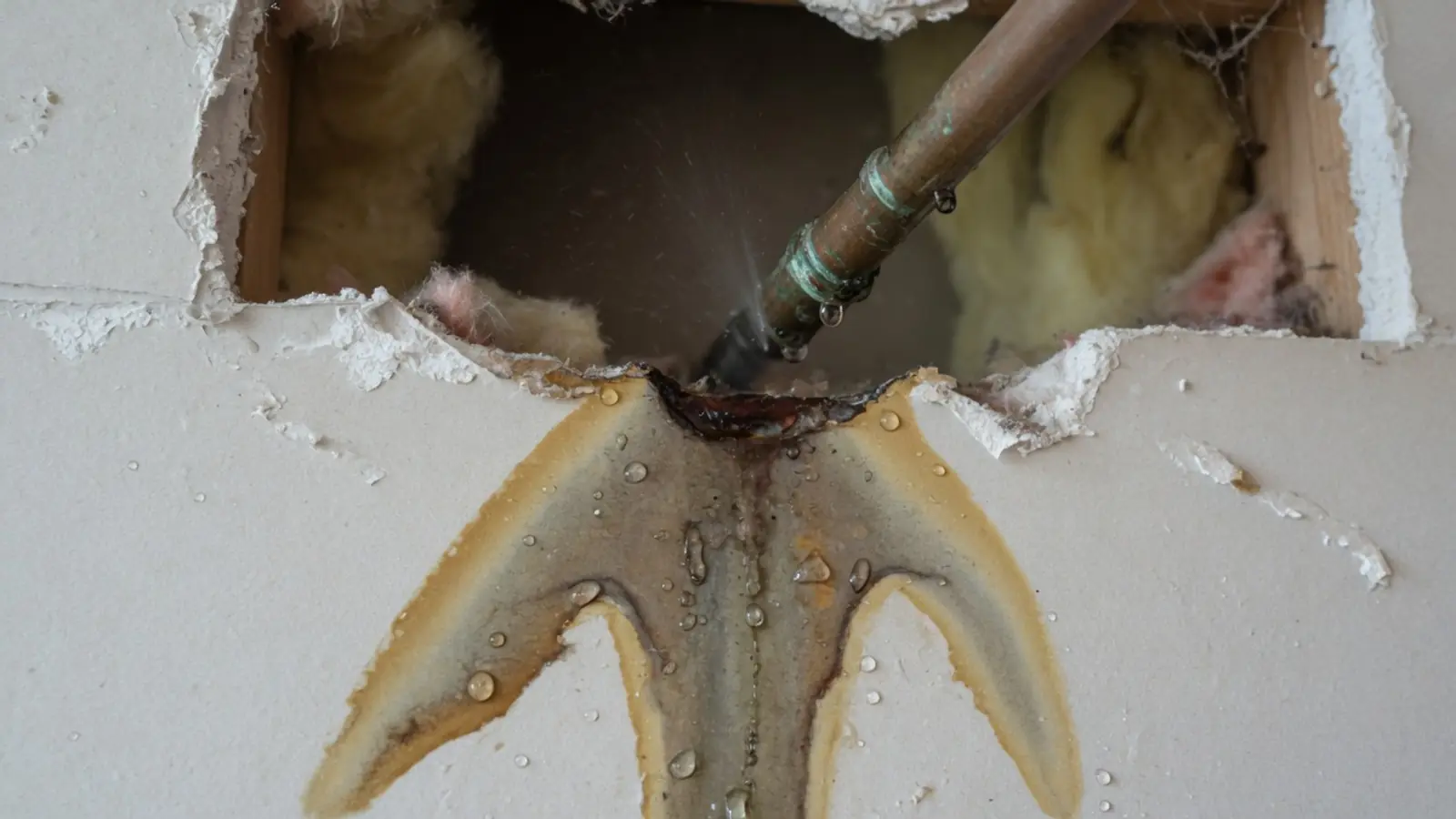
A supply pipe can spit a fine spray for weeks before anyone sees a puddle. Paint blisters. A baseboard stains. The bill ticks up. That is pinhole pipe leak water damage: a slow indoor leak, not an open burst.
This is not a burst-pipe emergency, not a slab leak, and not a fridge line. Those fail in different places. A pinhole in a wall or ceiling supply wets the cavity first.
Restore Pro SD matches you with a licensed independent restoration professional. We do not repair pipe, cut copper, or dry the house ourselves. You contract with that pro.
Confirm the pipe source is being addressed
Stop using the fixture on that run if you already know how. If you can reach the house shutoff without standing in water, shut it. If you cannot, leave it. A licensed plumber confirms the hole and stops the supply. Restoration does not make that repair.
Do not invent a pipe-material story. Older coastal cottages in Ocean Beach and Pacific Beach often have copper. Newer inland tracts in Mira Mesa, Santee, and Escondido often have PEX. That is not a failure-rate chart. Ask what actually failed.
CDC guidance is not to switch power on or off while standing in water. Call an electrician if the panel sits in the wet zone.
Trace slow leaks through walls and floors
A pinhole does not dump a room in minutes. Water follows the bay, the plate, and the subfloor. In a two-story Clairemont or Chula Vista house, the stain can show a floor below the pipe. In a slab home in San Marcos, water can sit at the bottom of the wall and migrate under vinyl.
Look past the first mark. Check the closet on the other side of the wet wall. Check the carpet edge in the hallway. Check the ceiling below a second-floor bath or laundry. EPA guidance is to fix plumbing leaks as soon as possible and dry items completely.
A matched restoration pro maps that with a meter. They compare wet spots with a dry room of the same materials. A stain the size of a dinner plate can sit over a wet bay that runs the length of the wall.
Check cavities beyond the first stain
Pulling a piece of drywall at the stain is not a full inspection. Moisture moves sideways. Insulation holds it. A bottom plate can wick into the subfloor.
If you suspect HVAC picked up mold from a nearby return, do not run the system to dry the house. The EPA says not to run HVAC you know or suspect is contaminated with mold.
Burst pipe cleanup is the matching page even when the failure is a pinhole instead of an open rupture. The indoor loss is still wet structure. Structural drying is the step after the plumber stops the spray.
Separate pipe repair from extraction and drying
Keep two files. The plumber’s invoice proves the pipe is closed. The restoration scope proves the cavity was mapped and dried. A patch over a wet bay is how the stain comes back.
The EPA says not to paint or caulk moldy surfaces. Clean, dry, then finish. If the moldy area is less than about 10 square feet, roughly a 3 ft by 3 ft patch, a homeowner can handle cleanup in most cases using EPA tips. If there has been a lot of water damage, or mold covers more than 10 square feet, consult EPA mold remediation guidance.
A specific City of San Diego or County permit rule for opening a supply bay could not be confirmed for this page. Check with the building authority for the property before anyone opens a wall that needs a permit.
Check the restoration pro on the CSLB license lookup. Restore Pro SD does not hold that license.
When to call us
Call when a slow supply leak has stained a wall or ceiling, when a plumber stopped a pinhole and the cavity is still wet, or when flooring next to that wall feels soft. Call us at (858) 400-4586 and we’ll connect you with a licensed local restoration pro.