
Last updated: April 23, 2026
Washing Machine Leak in San Marcos, CA.
Washing machine leaks are one of the highest-volume sudden water losses in San Diego County tract homes. Rubber hoses, failed valves, and drained overflows all create wide, fast footprints across laundry rooms and adjacent halls..
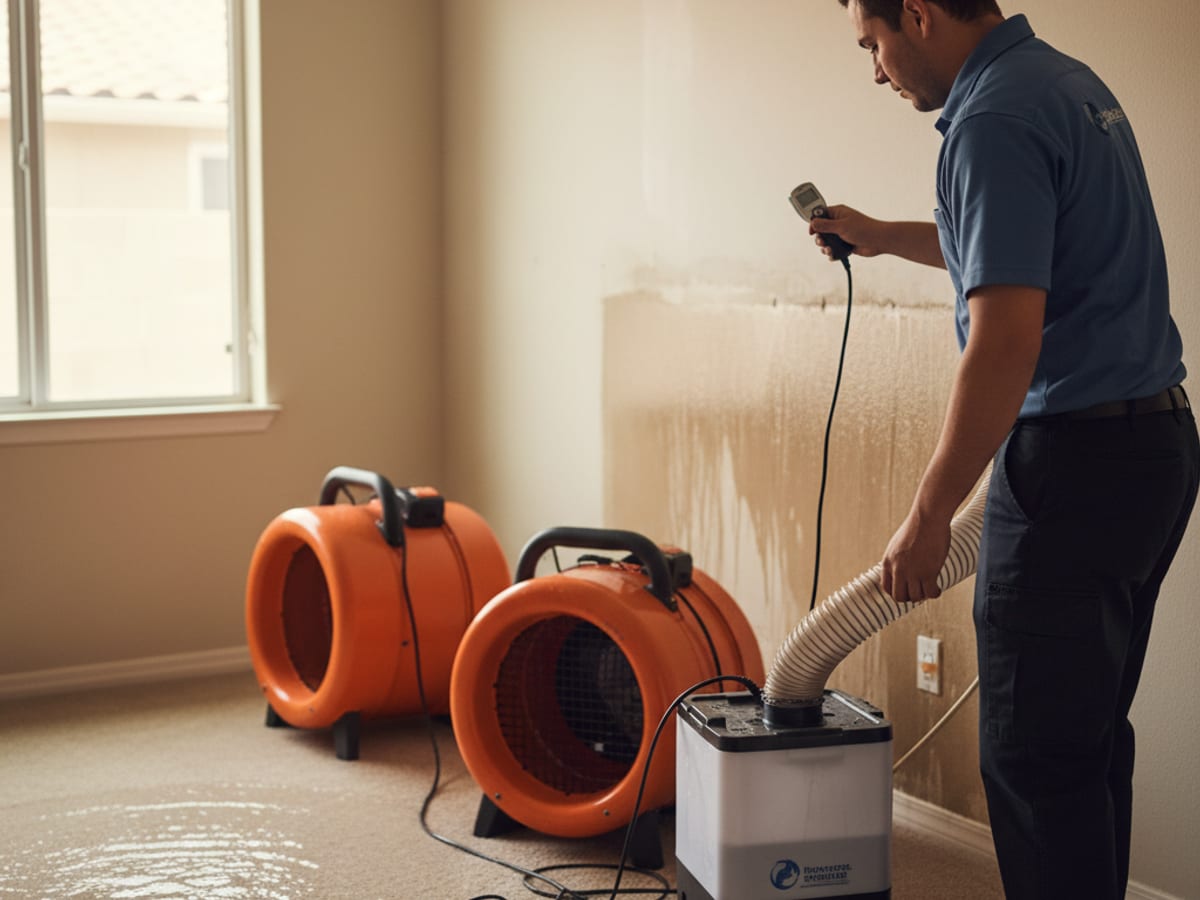
What washing machine leak means in San Marcos
In San Marcos, washing machine leak is a moisture problem first and a cosmetic issue second. San Marcos water damage scope reflects a young master-plan inventory and a substantial student-housing multi-family stock around California State University San Marcos and Palomar College. That local housing mix shapes where we look first when this symptom shows up.
Why washing machine leak shows up in San Marcos
Washer releases across Escondido, San Marcos, Vista, and Poway are classic high-volume sudden losses. In 1970s-90s tract homes with slab-on-grade construction, appliance supply failures and slab leaks dominate shows up as hose and valve failures, and lower ambient RH that still cannot save undried cavities affects how fast adjacent rooms need extraction.
- Common local pattern: appliance supply failures and slab leaks dominate
- Housing context: 1970s-90s tract homes with slab-on-grade construction
- Climate factor: lower ambient RH that still cannot save undried cavities
- Neighborhoods and cities in play: Escondido, San Marcos, Vista, and Poway
- Related restoration path: water damage restoration after moisture mapping
San Marcos homes and what they need
Slab-leak work in San Elijo Hills, Lake San Marcos, Rancheros, and the older Twin Oaks Valley tract follows the standard sequence, leak detection with a plumber partner, concrete saw-cutting for slab access, source repair, dry-out, mold remediation when needed, reconstruction.
Neighborhoods we cover for washing machine leak in San Marcos: San Elijo Hills, Lake San Marcos, Rancheros, Twin Oaks Valley, Discovery Hills, San Marcos Boulevard corridor, CSUSM adjacency.
San Marcos runs newer master-plan tract heavy, San Elijo Hills, Lake San Marcos, Rancheros, Twin Oaks Valley, with 1980s-2000s construction now in prime slab-leak window. CSUSM and Palomar College multi-family inventory drives steady apartment and condo work.
Common causes of washing machine leak
- Burst rubber supply hose versus steel-braided line failure
- Failed inlet valve flooding during a fill cycle
- Drain pump or standpipe overflow
- Laundry room slab or second-floor laundry wetting the ceiling below
- Pedestal and platform traps that hide pad-level moisture
- Hall and bedroom carpet wicking from a laundry release
Ready for restoration help? See water damage in San Marcos or the San Marcos service area page.
San Marcos washing machine leak questions
What usually causes washing machine leak in Escondido homes?
In this part of the county the leading pattern is appliance supply failures and slab leaks dominate. We moisture-map first, confirm whether the source is still active, and only then open walls or remove finishes.
Is washing machine leak an emergency in the North County Inland area?
A burst washer hose can release hundreds of gallons. Shut the valves and extract before water reaches other rooms. Locally, lower ambient RH that still cannot save undried cavities means waiting often makes the footprint larger than the first stain or puddle suggests.
What should I do about washing machine leak in San Marcos right now?
A burst washer hose can release hundreds of gallons. Shut the valves and extract before water reaches other rooms. In San Marcos, we moisture-map on arrival, stop active sources when we can, and start extraction or containment the same visit on active losses. Call (858) 400-4586.
Do you handle washing machine leak across North County Inland San Diego?
Yes. Washer releases across Escondido, San Marcos, Vista, and Poway are classic high-volume sudden losses. We serve San Marcos and nearby North County Inland communities with the same IICRC-based process.
Where we work in San Marcos
Get help with washing machine leak in San Marcos
Moisture mapping first. Mitigation when the loss is active.