
Last updated: April 23, 2026
Mold Inspect vs Remediate in Pacific Beach, CA.
Mold inspection and mold remediation are related but not the same job. Testing or visual assessment maps the problem; remediation contains and removes it, often with clearance testing afterward..
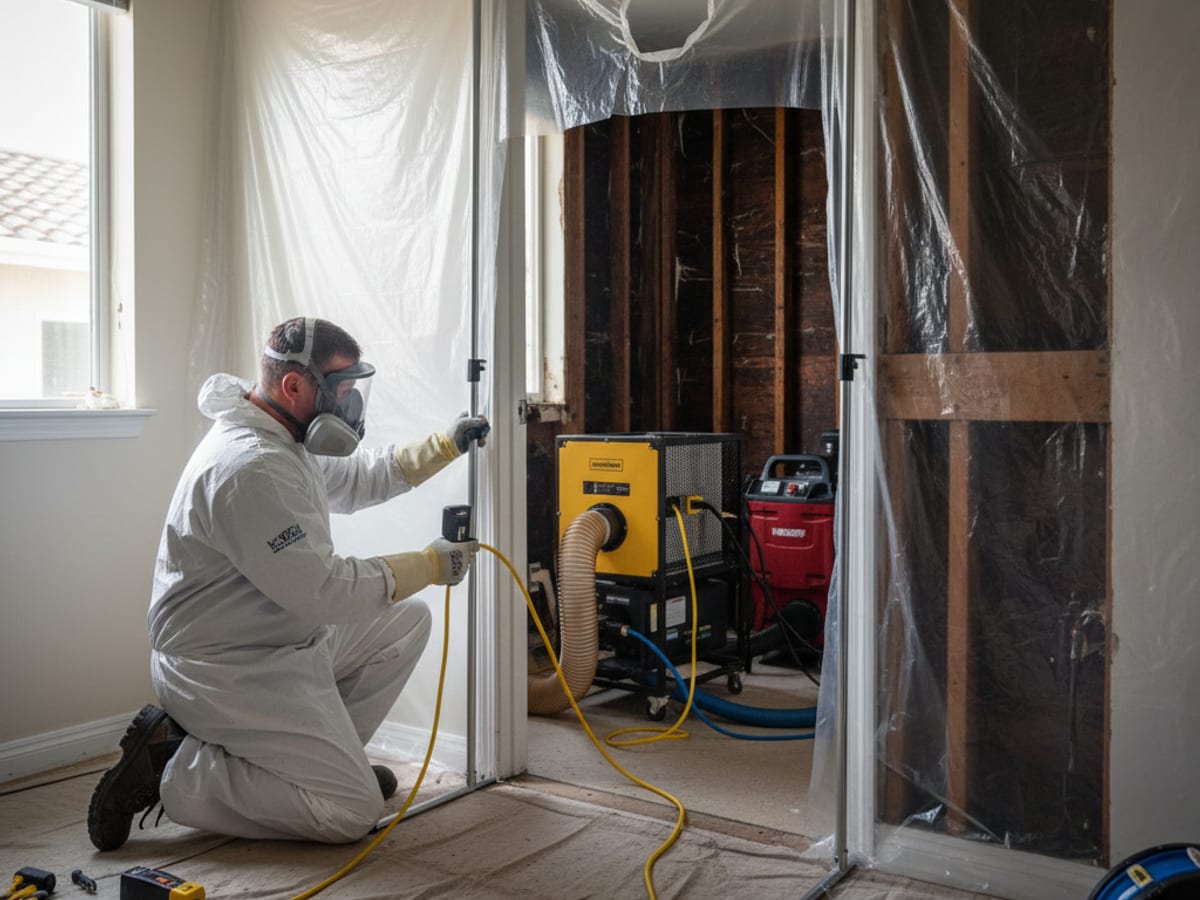
How mold inspect vs remediate works in Pacific Beach
In Pacific Beach, mold inspect vs remediate is a specialized restoration scenario, not a generic service page. Water damage calls in Pacific Beach run a different mix than anywhere else on the San Diego coast. That local housing mix shapes where we look first for this scenario.
Why mold inspect vs remediate shows up in Pacific Beach
Inspection-versus-remediation questions in Coronado, PB, OB, and Point Loma follow seized shutoffs and longer soaks before mitigation starts. Older beach bungalows and salt-air housing stock hides cavity growth, and marine-layer humidity that slows drying is why surface wipe-downs fail without a real dry-out.
- Local pattern: seized shutoffs and longer soaks before mitigation starts
- Housing stock: older beach bungalows and salt-air housing stock
- Climate factor: marine-layer humidity that slows drying
- Cities in this region pattern: Coronado, PB, OB, and Point Loma
- Related service path: mold remediation
Pacific Beach homes and what they need
The Pacific Beach scope mix shapes how we staff and equip.
Neighborhoods we cover for mold inspect vs remediate in Pacific Beach: North Pacific Beach, South Pacific Beach, Crown Point, Garnet Avenue corridor, Reed Avenue area, Tourmaline area, Mission Bay frontage.
Pacific Beach is dense multi-family stock, apartments, condos, beach-block duplexes, taking direct salt and humidity. Cat 2 and Cat 3 sewage backups in older buildings, plus rooftop deck waterproofing failures dropping water into the units below, drive most of the call volume here.
What mold inspect vs remediate usually involves
- When visual assessment is enough to start containment
- When third-party sampling is required by a carrier or buyer
- Remediation under IICRC S520 containment
- Clearance testing after larger jobs
- Why cleaning spots without drying fails
- Source moisture repair paired with removal
Ready for restoration help? See mold remediation in Pacific Beach or the Pacific Beach service area page.
Pacific Beach mold inspect vs remediate questions
How do you handle mold inspection vs remediation in Coronado?
We start with moisture mapping and category assessment, then mitigation matched to the loss. In this region that often means accounting for seized shutoffs and longer soaks before mitigation starts inside older beach bungalows and salt-air housing stock.
Is mold inspection vs remediation urgent in the Coastal area?
Inspection answers what and where. Remediation removes colonized material under containment. They are different scopes. Locally, marine-layer humidity that slows drying means delays usually widen the footprint.
What should I do about mold inspect vs remediate in Pacific Beach right now?
Inspection answers what and where. Remediation removes colonized material under containment. They are different scopes. In Pacific Beach, the scope starts with moisture mapping and source review. Those findings determine whether extraction, containment, or structural drying is needed. Call (858) 400-4586.
Do you handle mold inspect vs remediate across Coastal San Diego?
Yes. Inspection-versus-remediation questions in Coronado, PB, OB, and Point Loma follow seized shutoffs and longer soaks before mitigation starts. We serve Pacific Beach and nearby Coastal communities with the same IICRC-based process.
Where we work in Pacific Beach
Get help with mold inspect vs remediate in Pacific Beach
Moisture mapping first. Mitigation when the loss is active.