
Last updated: April 23, 2026
Mold Clearance Testing in Lakeside, CA.
Mold clearance testing is the post-remediation check many carriers, buyers, and property managers require before reconstruction. It is separate from the remediation work itself..
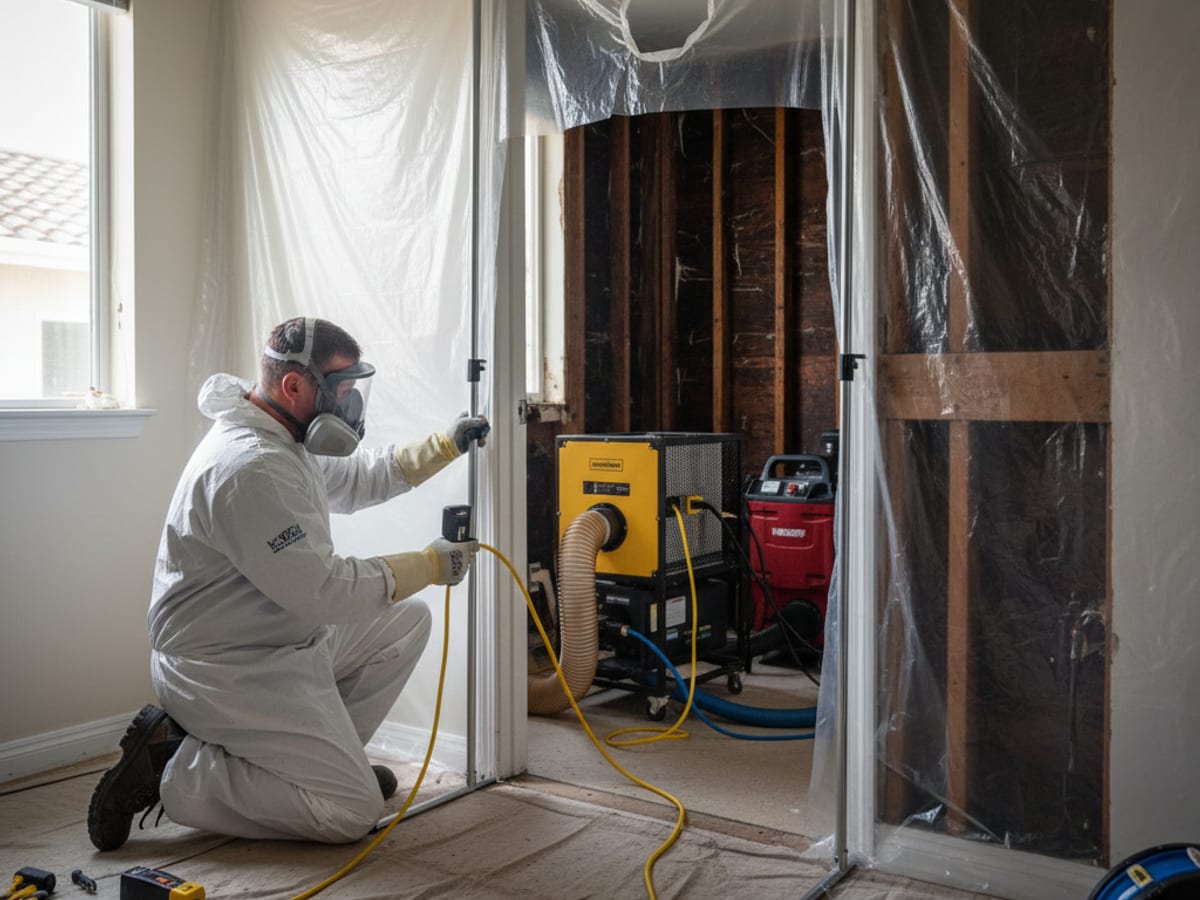
How mold clearance testing works in Lakeside
In Lakeside, mold clearance testing is a specialized restoration scenario, not a generic service page. Lakeside water damage scope reflects the area's mix of rural-residential and tract construction. That local housing mix shapes where we look first for this scenario.
Why mold clearance testing shows up in Lakeside
Mold Clearance Testing work around El Cajon, Santee, and Lakeside often follows slab leaks and roof or runoff events. In slab tracts and canyon-adjacent homes, dry air that helps drying shapes how fast the job moves after the first visit.
- Local pattern: slab leaks and roof or runoff events
- Housing stock: slab tracts and canyon-adjacent homes
- Climate factor: dry air that helps drying
- Cities in this region pattern: El Cajon, Santee, and Lakeside
- Related service path: mold remediation
Lakeside homes and what they need
Slab-leak work in the older 1970s-80s ranch and tract stock follows the standard sequence, leak detection, slab access, source repair, dry-out, mold remediation when needed, reconstruction.
Neighborhoods we cover for mold clearance testing in Lakeside: Lakeside proper, Wildcat Canyon area, Lake Jennings perimeter, El Monte Valley, Eucalyptus Hills, Maine Avenue corridor, San Diego River corridor.
Lakeside rural-residential stock mixes older 1960s-80s ranch homes with newer custom builds. Well water and septic common on the larger parcels around Lake Jennings and the Wildcat Canyon area. The San Diego River corridor through Lakeside adds flood-zone calls during atmospheric river events.
What mold clearance testing usually involves
- When carriers require third-party clearance
- Air and surface sampling after containment comes down
- Passing criteria set by the hygienist protocol
- Failed clearance and what gets re-cleaned
- Timing relative to reconstruction
- Documentation packet for the claim file
Ready for restoration help? See mold remediation in Lakeside or the Lakeside service area page.
Lakeside mold clearance testing questions
How do you handle mold clearance testing in El Cajon?
We moisture-map first, then run the scope that matches category and access. In this region that usually means accounting for slab leaks and roof or runoff events inside slab tracts and canyon-adjacent homes.
Is mold clearance testing urgent in the East County area?
Clearance testing happens after remediation, not before. A third-party hygienist confirms the space is ready to rebuild. Locally, dry air that helps drying means delays usually widen the footprint.
What should I do about mold clearance testing in Lakeside right now?
Clearance testing happens after remediation, not before. A third-party hygienist confirms the space is ready to rebuild. In Lakeside, the scope starts with moisture mapping and source review. Those findings determine whether extraction, containment, or structural drying is needed. Call (858) 400-4586.
Do you handle mold clearance testing across East County San Diego?
Yes. Mold Clearance Testing work around El Cajon, Santee, and Lakeside often follows slab leaks and roof or runoff events. We serve Lakeside and nearby East County communities with the same IICRC-based process.
Where we work in Lakeside
Get help with mold clearance testing in Lakeside
Moisture mapping first. Mitigation when the loss is active.