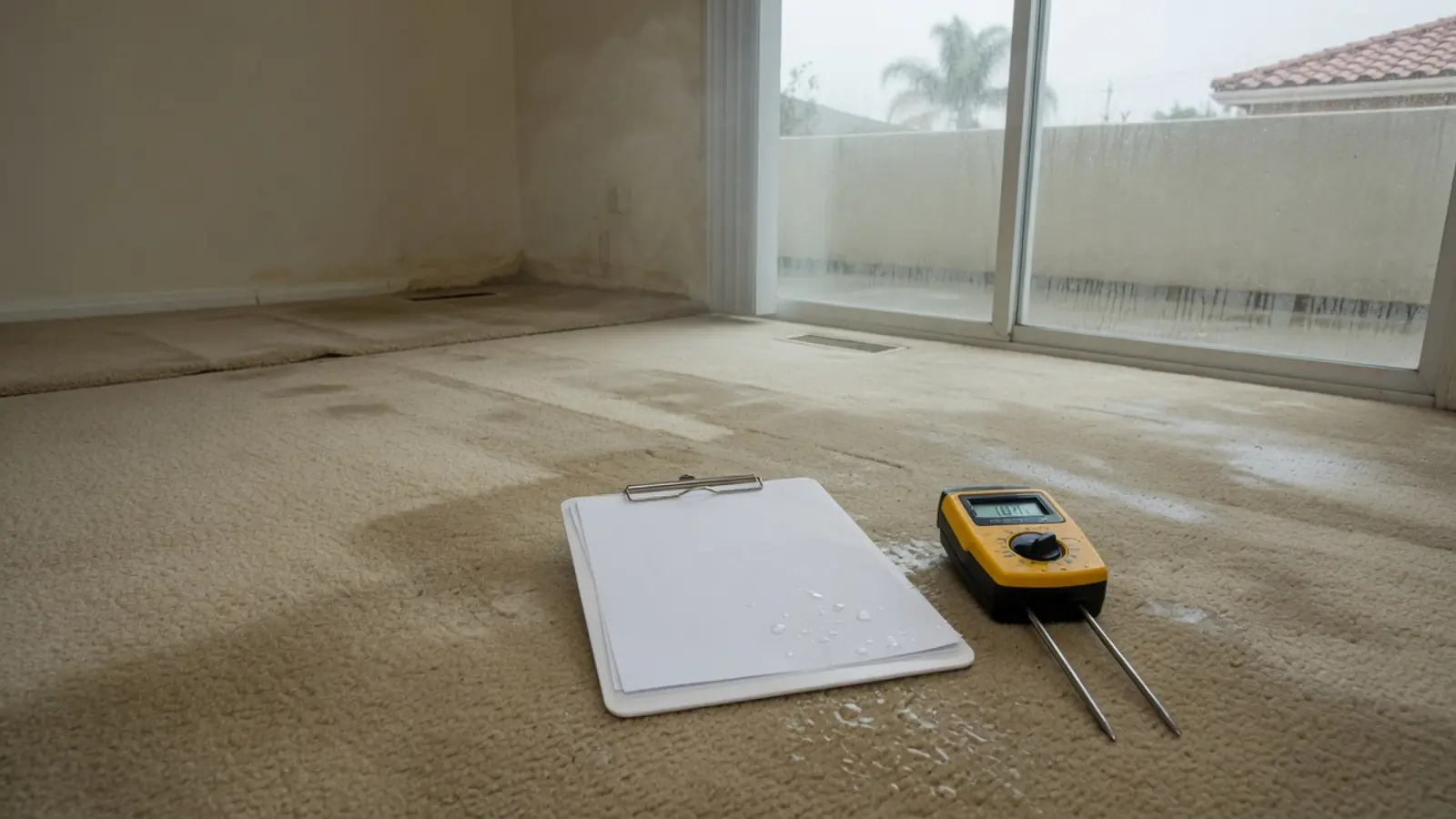
Insurers and contractors use two words for one wet house. Mitigation is the stop-and-dry work: extract standing water, map moisture, remove what cannot dry, and document the rooms. Restoration is the put-back: drywall, paint, flooring, and finishes. Water mitigation vs restoration is that split, not two brands of the same visit.
Restore Pro SD matches you with a licensed independent restoration professional. We do not mitigate, rebuild, quote a price, or file the claim. You contract with that pro. Ask your carrier about your own policy.
Mitigation is the wet work
Mitigation starts while the house is still wet. Standing water comes out. Wet pad and wet drywall that cannot dry in place come out. A moisture map names what is still wet in the wall, the plate, and the subfloor. A drying log tracks those readings until remaining materials hit a documented dry goal.
Emergency water extraction is the standing-water piece. Structural drying is the moisture-map piece. What extraction removes is the process page for the pump. Mitigation is those steps as a set.
EPA guidance is to fix plumbing leaks and other water problems as soon as possible and dry items completely. If sewage or other contaminated water caused the damage, call a professional experienced with that work. That still sits on the mitigation side.
Stay out of standing water. CDC guidance is not to switch power on or off while standing in water.
Restoration is the put-back
Restoration in this sense is rebuild. Texture, paint, trim, and flooring go back after the assembly is actually dry. Painting a stain while the cavity is wet is not restoration. The EPA says not to paint or caulk moldy surfaces. Clean, dry, then finish.
Ask whether the independent pro’s license and scope cover rebuild, or only mitigation. Some pros stop when the rooms are dry. A separate tradesperson hangs the drywall. That is a hiring choice, not a defect.
A City of San Diego or County permit rule for putting drywall back could not be confirmed as a single countywide number. Check with the building authority for the property.
Why the invoice should name both
A single line that says “water damage restoration” hides the split. Adjusters often want mitigation documented as its own file: photos, readings, what was removed. Rebuild is a second file. Restore Pro SD does not file those claims. You keep the notes for your own records.
Inland houses in Escondido, Poway, and El Cajon can feel dry at the surface while a closed bay is still wet. Coastal houses in Oceanside and Pacific Beach keep ambient moisture in the same assemblies. The map has to use a dry room of the same materials as a baseline, not a guess from how the living room feels.
If HVAC may be contaminated with mold, do not run it to finish mitigation. The EPA says not to run HVAC you know or suspect is contaminated with mold.
What to ask the independent professional
- Which rooms are mitigation only, and which include rebuild.
- How they will meter hidden moisture, not only the stain.
- What they expect to remove versus dry in place.
- What notes you will get before anyone closes a wall.
- Whether a plumber, roofer, or electrician has to finish first.
Water damage restoration is the matching page. Check the restoration pro on the CSLB license lookup. Restore Pro SD does not hold that license.
Call Restore Pro SD at (858) 400-4586. The line takes a recorded message. We match you with a local licensed restoration professional. They contract with you directly.