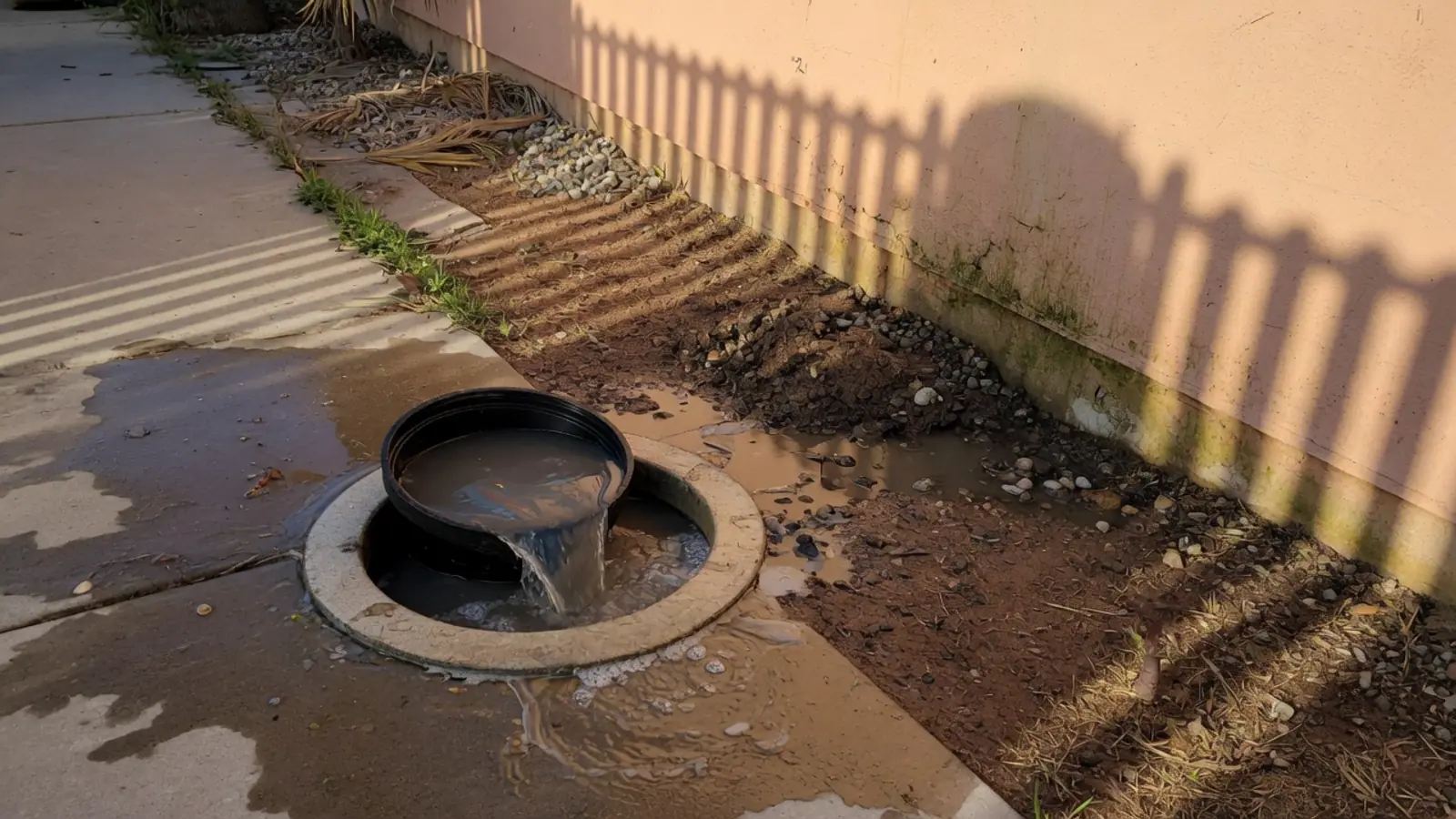
Wastewater is coming up a capped pipe in the yard, the driveway, or along the foundation. That is a sewer cleanout overflow: the line is blocked, and the cleanout is the relief. It is not a toilet overflowing inside, and it is not a patio drain in a rainstorm.
If that water reached a slab, a garage, a crawl, or an interior floor, the indoor side is sewage cleanup. EPA guidance is to call a professional experienced with contaminated-water damage.
Restore Pro SD matches you with a licensed independent restoration professional. We do not clear sewer lines or dry the house ourselves. You contract with that pro. A licensed plumber stops the backup.
Stay out of the overflow and stop indoor use
Keep people and pets off the spill. Do not mop it toward a door. Do not run a household shop vacuum on it. Photograph from a dry spot.
Stop flushing and running water in the house until a plumber has a working theory of the stoppage. Every flush adds volume to the same line that is already relieving at the cleanout.
If the overflow reached indoor rooms, stay out of that water. CDC guidance is not to switch power on or off while standing in water.
A toilet-only overflow with a clear trap is a smaller cousin. If that is what you actually have, see toilet overflow cleanup. Several fixtures reacting at once, or wastewater at the outdoor cleanout, points farther down the line.
Find who owns the line at this property
A cleanout in the yard can sit on a private lateral or near a public main. That split is set by the sewer agency for the property, not by this page. In the City of San Diego, start with the city’s wastewater contacts. In other cities, start with that city’s public-works desk. Unincorporated pockets sit with the County. If the authority for your address could not be confirmed here, call the city or county and ask who owns the line past the cleanout.
If several neighbors on the same block see backups at once, say so when you call. A shared main behaves differently than a single clogged lateral.
Storm runoff is a separate path. Heavy rain can load area drains and, on some lots, mix with a struggling lateral. Treat mixed water that entered the house as contaminated until the matched pro and the plumber say otherwise.
Check whether wastewater reached the house
Look at the slab edge, the garage, the crawl hatch, and the lowest interior floor. A cleanout against a Chula Vista or National City stucco wall can wet the plate from outside. A mid-block bungalow in North Park can take it under a garage door. A hillside house in La Mesa or El Cajon can send it along a stem wall.
If it stayed in the soil and never crossed a threshold, indoor restoration may not be the job. The plumber and the sewer agency still own the line. If it crossed into finished rooms, pad, drywall, and contents are a contaminated-water loss.
Do not run HVAC if you know or suspect the system is contaminated with mold. The EPA says it can spread mold through the building.
Separate line repair from indoor cleanup
The plumber or the sewer agency clears the stoppage. The restoration pro maps indoor rooms, removes what cannot be cleaned, and dries remaining structure. Mixing those invoices is how a cleared line sits under a still-wet pad.
Ask the matched pro how they will keep clean rooms clean, which materials they expect to remove, and what notes you will get for your own file. Restore Pro SD does not file the claim.
Check the restoration pro on the CSLB license lookup. Restore Pro SD does not hold that license.
When to call us
Call when a cleanout overflow reached a garage, a crawl, a slab edge, or an interior room, or when a plumber cleared the line and indoor finishes are still wet and dirty. Call us at (858) 400-4586 and we’ll connect you with a licensed local restoration pro.