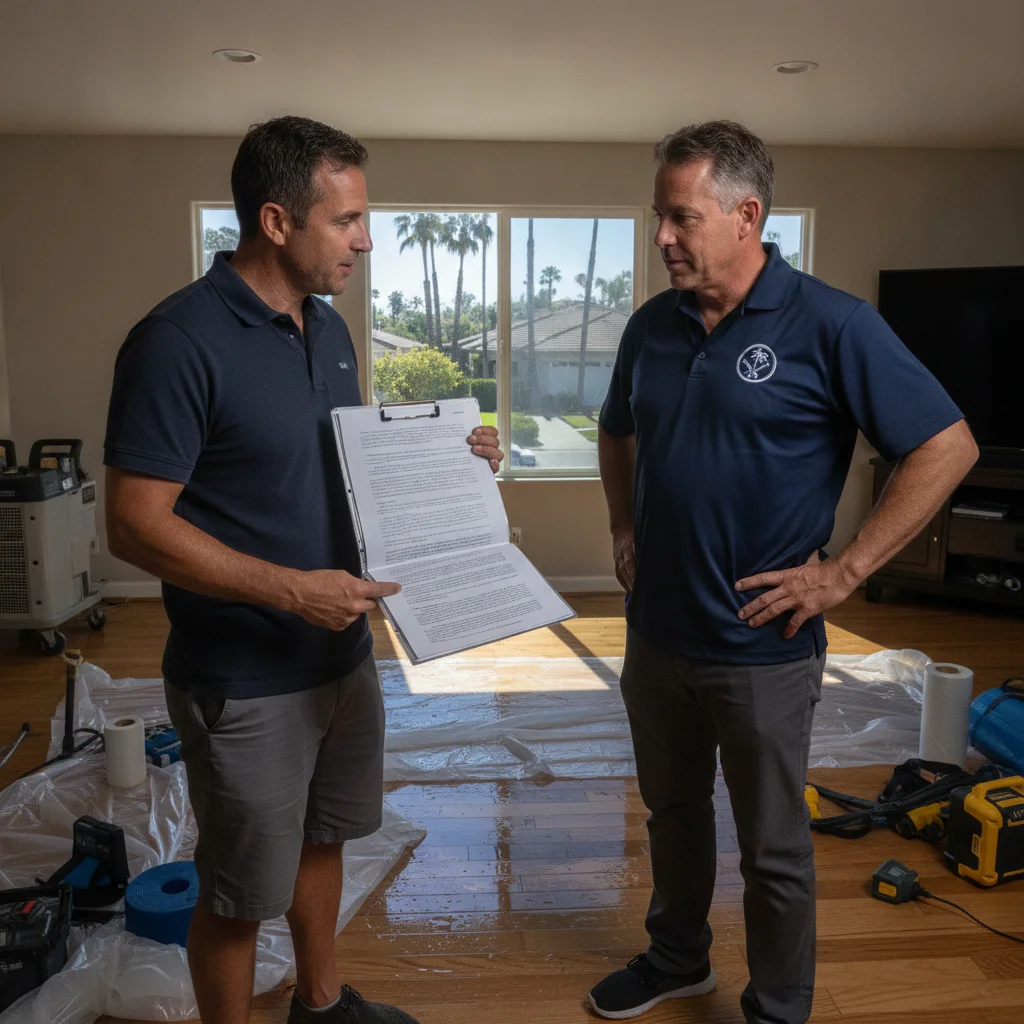
Emergency water damage restoration services should begin with source control, a property-specific assessment, and a written scope. Before choosing a pro, make sure the proposal separates removal, drying, cleaning, documentation, and repairs. That comparison matters more than a broad promise to handle everything.

A San Diego County homeowner comparing written restoration scopes with an independent local professional

Start with source control and an independent assessment

Start by asking each pro to identify the water source. The written scope should say whether that source has been stopped. If it hasn’t, the proposal should explain who’ll address it.

Source repair and water damage restoration aren’t always presented as one service. Don’t assume either task is included without seeing it in writing. Ask the pro to separate the source issue from the affected materials and planned restoration work.

A useful proposal should follow a direct property assessment. Let each candidate document their own findings instead of relying only on another company’s description. The assessment should identify the affected rooms, visible materials, and areas requiring closer checks. It should also mark anything the pro couldn’t inspect.

Ask how the proposed work fits your actual San Diego County property. Note whether it’s in coastal North County, inland North County, the central city, East County, or South Bay. Building type, access, occupancy, and affected materials should appear in the discussion. A generic scope copied between properties gives you little help when comparing services.

Restore Pro SD is a referral service serving 67 cities across San Diego County. We match homeowners with licensed, independent local professionals. We don’t perform restoration work or employ the crews completing it. Our water damage restoration service page explains that matching role.

Keep the early conversation focused on findings and scope. Ask the candidate to distinguish confirmed conditions from assumptions. If something couldn’t be confirmed, the scope should say who’ll check it and when that decision enters the work plan.

Separate extraction, drying, cleaning, and repairs

A single line labeled “water restoration” doesn’t show enough detail. Ask each professional to divide the proposed work into distinct phases. That makes omissions, overlaps, and conditional work easier to spot.

Scope phaseWhat the written proposal should identify
AssessmentAffected rooms, materials examined, visible conditions, and inspection limits
ExtractionIncluded areas, affected materials, and handling of removed water
DryingTargeted materials, proposed equipment, monitoring method, and completion basis
CleaningIncluded surfaces, materials, contents, and disposal decisions
RepairsItems proposed for removal, replacement, rebuilding, or separate approval

Ask whether moving contents, removing materials, cleaning surfaces, and disposing of debris belong to the quoted scope. Have the pro mark each item as included, excluded, or conditional. Don’t rely on a verbal “we handle it” statement.

Extraction and drying should also appear as separate work. If standing water is your immediate concern, read our emergency water extraction guide before comparing proposals. It focuses on extraction, while restoration can involve several additional phases.

Repairs need their own boundaries. Ask which affected finishes or building materials the professional plans to remove. Then ask whether replacement work appears in the same agreement or requires another proposal. The answer should be written plainly.

This separation helps when two candidates use different service labels. Compare the tasks, not just the headings. One proposal may place cleaning under drying. Another may list it independently. What matters is whether each required decision has an owner, a written scope, and a clear approval point.

Ask how moisture conditions will be documented

Ask every candidate to explain how they’ll document moisture conditions. The answer should describe a repeatable record, not a vague statement that materials will be checked. You should understand what gets recorded and how those records connect to the affected areas.

Request documentation that identifies:

  • The rooms and materials included in the assessment
  • Initial observations tied to specific locations
  • Moisture readings with their measurement locations
  • Notes explaining added, removed, or redirected work
  • A closing record for the conditions the pro evaluated

Ask what measurement tools and methods the professional proposes to use. You don’t need to interpret every reading yourself. You do need a record that shows where it came from and what decision followed.

Photos can add context, but they shouldn’t replace written location details. A close image of a damp material may not identify the room or surface. Ask how photos, notes, and readings will be labeled together.

Also ask what happens when a previously inaccessible area becomes available. The scope should explain how new observations will be recorded. It should also describe how the pro will present any proposed change before adding work.

Keep copies of the scope, updates, and final documentation. If the professional uses a customer portal, ask how you’ll retain the records after the job. If a documentation method can’t be confirmed, state that gap during your comparison. Ask the professional to explain it before you choose.

A service scope divided into assessment, extraction, drying, cleaning, documentation, and repairs

Compare exclusions before choosing a local pro

Two proposals can use similar headings while covering different work. Build a side-by-side list with four columns: included, excluded, conditional, and customer responsibility. Place every unclear item into one of them.

Check how each proposal handles these subjects:

  • Repairing or controlling the original source
  • Moving or protecting contents
  • Removing affected materials
  • Cleaning included surfaces and items
  • Disposing of removed materials
  • Documenting moisture conditions
  • Replacing finishes or building materials
  • Approving work added after the assessment

Don’t treat a blank space as an inclusion. Ask the professional to mark it. If the answer remains uncertain, record it as unconfirmed rather than filling the gap yourself.

Pay close attention to conditional phrases. “As needed” doesn’t explain who decides, what evidence supports the decision, or how the change gets approved. Ask for the decision process in writing. The same applies when a proposal refers to work by another trade or company.

An emergency water damage restoration near me search may show several providers with similar service descriptions. Their exclusions can reveal more than their promotional language. Compare what each professional commits to documenting, performing, and leaving outside the contract.

Restore Pro SD doesn’t set the independent professional’s prices. We also don’t issue warranties or enter the restoration contract. The customer contracts with and pays the selected professional directly. Ask that professional how scope changes, payment terms, and any offered warranty will be documented. If a term isn’t written or verifiable, treat it as unconfirmed.

Verify credentials through current official sources

Credential checks should match the business named on the proposal. Ask for the professional’s legal business name and license details. Then check the current record through the CSLB license search.

Compare the search result with the proposal before signing. If the details don’t match, ask the professional to explain the difference. Don’t guess that two similar names belong to the same business. If a license detail can’t be confirmed, record it as unconfirmed and request corrected information.

Treat every additional credential the same way. Ask for the issuing organization, exact credential name, named holder, and current verification source. A logo or badge alone doesn’t confirm the holder or status. Check the issuer’s current records when available.

If mold or moisture cleanup appears in the scope, review the EPA’s mold and moisture guidance. Use it to frame questions about the proposed work. Ask the professional to state which tasks are included and which require separate approval.

Restore Pro SD matches customers with licensed, independent water damage professionals. Restore Pro SD itself doesn’t hold a trade license, perform physical work, or provide warranties. That distinction should remain clear from the first call through the signed agreement.

Before choosing a water damage restoration professional, confirm five things in writing: the assessed areas, separated work phases, documentation method, exclusions, and current credentials. If any point remains uncertain, label it unconfirmed. Ask the person or issuing authority responsible for that detail to verify it.

When to call us

Call when water damage requires an assessment and a clearly defined scope from a licensed Water Damage Restoration pro. Call us at (858) 400-4586 to hear the recording-consent notice, then leave a recorded and transcribed message.